

Today, the topic of unidentified anomalous phenomena spreads as institutional trust shrinks, and people look for answers that academia and legacy media can’t or won’t provide. Is there a false narrative being pushed, or are facts slowly leaking into the mainstream media? There is a progression of discourse that is happening in the United Sates, so I took it upon myself to mark some steps.
Tracking Disclosure
UAP Status is a framework that indicates the level of engagement. How does one read, write, speak, or otherwise engage the topic of UAP in a non-fiction context? There is an enormous difference in talking about pilots seeing unidentified objects flying alongside them, vs abduction cases and alien sightings. Public officials face enormous stigma and social pressure to relegate discussion of UAP to comedy, or to not speak about it at all. How does this frame of discourse affect the actual progress towards finding the truth behind these phenomena?
UAP Status represents the willingness to speak against the stigma, and accept the trail of evidence wherever it points.
UAP Status takes the current narratives and patterns of discourse around UAP, and non-destructively compresses them into five levels. Here I’ll explain each level, or “Status”, and give some relevant examples of each, using clips of sworn testimony inside congressional hearings.
UAP Status 1
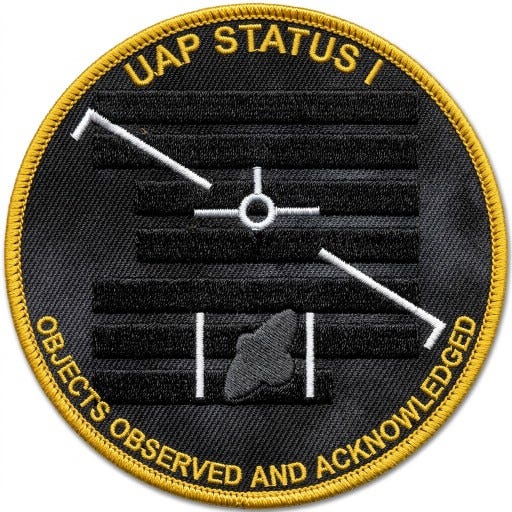
Status 1 is the acknowledgement that UAP are real, and are not just misidentified objects and hoaxes. This is the first step, and it’s an easy bar to cross. Status 1 makes no claims about what the unidentified objects are. Instead, speaking at Status 1 is a conservative acknowledgement that some of these objects are unidentified due to lack of data, or some unknown unknown.
As of May 4, 2026 President Trump and most federal agencies (including the CIA and AARO) acknowledge the existence of UAP, but stop short at admitting that some cases may indeed represent something exotic.
Video explanation of Status 1 with examples..
UAP Status 2
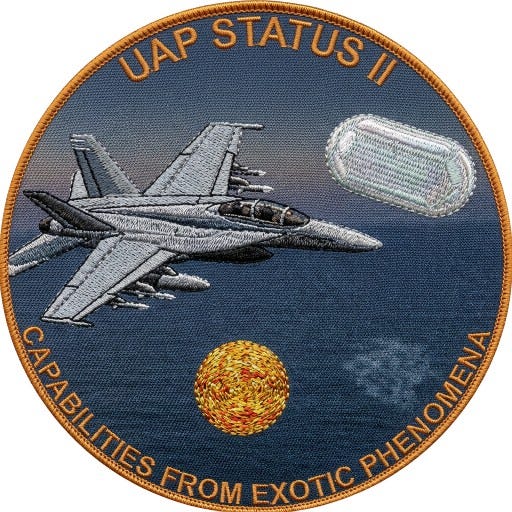
Status 2 acknowledges that UAP are not just anomalous and unidentified- they are attributed to something exotic. Let’s get our terms straight. Anomalous means that the phenomenon doesn’t fit into any known dataset (things can appear anomalous but be ordinary). Exotic means the phenomenon defies the limits of human engineering, and possibly defies our current model of physics. The Tic Tac UFO of 2004 and the objects described by Air Force police officer Jeff Nuccetelli in the example below are all exotic.
Explanation of Status 2 with examples.
Arthur C. Clarke summed up Status 2 in famous quote better than I ever could.
Any sufficiently advanced technology is indistinguishable from magic.
The exotic label also includes paranormal phenomena, creature sightings and poltergeist activity, such as those recorded in the Defense Intelligence Agency’s Advanced Aerospace Weapon Systems Applications Program (AAWSAP).
While people who speak at Status 1 describe UAP as simply misidentified ordinary objects, Status 2 accepts that some phenomena are truly extraordinary. Flying orbs, triangles, saucers, or other mysterious aerial craft are exotic because they appear to be impossible. In three words, exotic is magic.
Clarke’s other two Laws explain the thinking behind Status 2 quite well.
When a distinguished but elderly scientist states that something is possible, he is almost certainly right. When he states that something is impossible, he is very probably wrong.
and also…
The only way of discovering the limits of the possible is to venture a little way past them into the impossible.
UAP Status 3
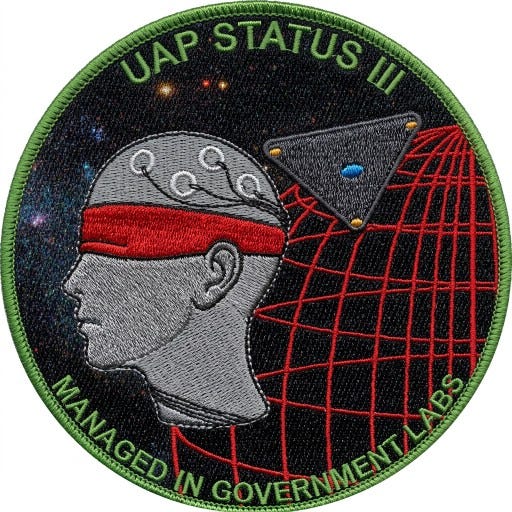
Status 3 asserts that not only do exotic phenomena exist, they are studied inside labs and special access programs, and kept secret from the public. It would be no surprise that if exotic phenomena existed, it would be extremely advantageous to reverse engineer and master it. Status 3 asserts that elements inside the US government, and potentially other state or private organizations have acquired, studied, and developed their own applied knowledge from UAP.
Explanation of Status 3 with examples.
If we assume that no organization is perfect at keeping secrets, then leaks are to be expected. Today, some of these leaks have been whistleblowers who have testified to congress.
A fundamental part of the classified world is that if you don’t know what to look for, you will never find it. Anyone who has ever submitted a Freedom of Information request knows this. Without knowing program names or critical details, investigations can hardly turn up anything useful.
Notable examples include the revelation of the Advanced Aerospace Threat Identification Program in 2017, the revelation of the larger AAWSAP program in 2021, and whistleblower Matthew Brown’s compiled report on Immaculate Constellation, an alleged unacknowledged special access program whose primary mission was to collect imagery of UAP. All of these programs were unknown to the world until insiders with security clearances voluntarily revealed their existence.
Is it reasonable to believe that there are no secret programs that study UAP, simply because we haven’t heard of them? In the classified world, preserving secrecy means a job well done. Status 3 asserts that UAP programs can and do exist. By extension, relying on official statements and unclassified data will lead to an incomplete picture of the truth.
UAP Status 4
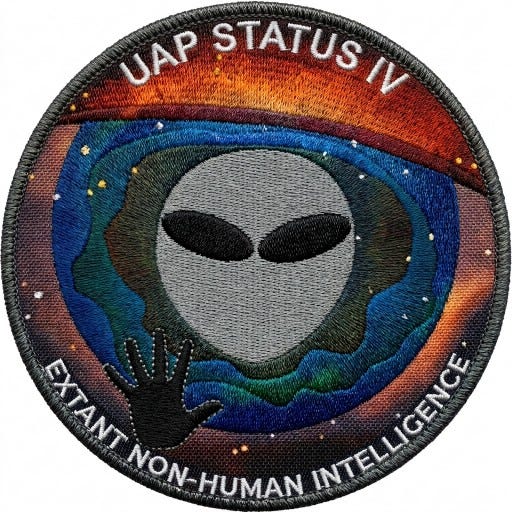
Status 4 is simple. Non human intelligence is real, and it has visited Earth. Despite about half of the world believing in the existence of some form of alien life, there is great stigma around publicly committing to any public opinion beyond that. Status 4 accepts that non-human intelligent life not only exists, but that it is also possible to appear and interact with us on Earth.
Explanation of Status 4 with examples.
No, non-human intelligence is not necessarily gray alien extraterrestrials. The term NHI is used by people today as a catch-all term. Status 4 is about broaching the topic that NHI can exist, so what do we do about it?
Surprisingly, NASA, who is publicly at Status 1, has had internal deliberations about media and science protocols for NHI should it be discovered. This is a great example of Status 4. Unfortunately, as of writing this article, NASA hasn’t commented on the contents of this FOIA release, despite one of the people mentioned inside is a public facing astrobiologist who was a part of NASA’s 2023 UAP Report.
UAP Status 5
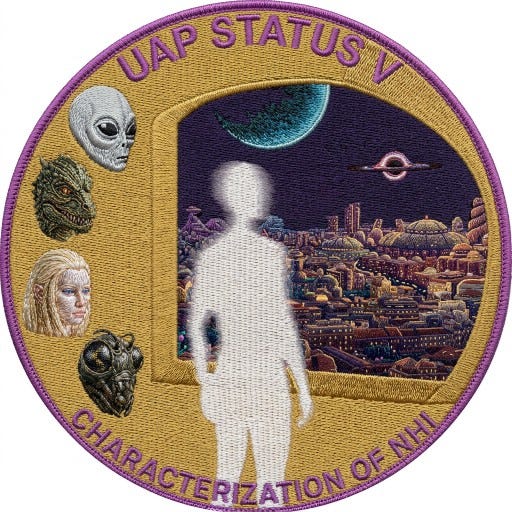
Status 5 is about characterizing multiple forms of non-human intelligence in relation to humans. Alien origins and features are described in direct relation to those of humans.
While Status 4 might begin with discussions of “are they real?”, and “where are they?”, Status 5 discussions begin with “what do they look like?”, and “how tall are they?”. Some of the more common narratives of these humanoid forms of NHI are of “races” like grays, Nordics, reptilians, mantis beings, and even divine entities such as angels, demons, and more.
Incredibly, multiple members of congress and vice president J.D. Vance have spoken at Status 5.
Explanation of Status 5 with examples.
Note about AI: All patch artwork was designed and composed in photoshop by me. Some of the higher detail images like the alien masks and background city came from generative AI. Generative AI was also used to style render each image as an embroidered patch.
An Important Note About Belief
Beliefs are personal and unmeasurable, and they often change over time. Most public facing people, especially politicians, keep their beliefs to themselves.
Speaking at Status 4 does not indicate one believes that aliens are real. Imagine if a close family member told you they saw a flying saucer. Imagine they told you that it flew past their car, and as it passed by, the car engine suddenly stopped. They tell you color of the lights, their best estimate of the speed, and how long it was visible in the air. Would you believe them?
Let’s look at a more grounded situation. Say that your partner comes home with a small cut on her ankle after a walk at the park. She tells you she was bit by a dog. An enormous dog! Big as a bear! What kind of dog? She doesn’t know, but it was big and brown, and she tells you the bite mark was small because she leapt away in fear before the dog ran off to its owner’s call. She shows you the mark, and the cut is tiny. Your skeptical brain thinks that the dog couldn’t possibly have been as big as your partner says. She might be exaggerating because she was scared. She probably wants you to take her seriously. She might feel an incentive to lie. And besides, you’ve never seen any big dogs at the park…
Let’s say you do believe her. What makes you believe her story? Is it her past credibility? Her incentives to tell the truth? Her emotional distress might indicate she is telling the truth. A bite from a big dog is scary. Maybe your empathy and emotional connection for her helps you believe her story. Maybe she told it in such a compelling way, that you were emotionally moved. Maybe you have seen bear-sized dogs before, so it’s not that surprising.
So at the end of the day, you’re left with some level of belief.
But what does that get you? Really, what does belief do for you in this situation?
This is an important question we can only answer ourselves.
My point is that belief is too ephemeral. Belief alone doesn’t get us closer to the truth. Only engagement does. Does a detective believe that one of her listed suspects is guilty or innocent? Does she take them at their word? If her investigation is unfinished, the binary concept of belief is the wrong framework to use.
Belief vs Value
Underneath the rather useless question of belief is something basic. Are these stories important to you? These encounters do not affect you directly. They only affect you because they affect the people around you. This is not about belief. It’s about value.
We are talking about the things we value, in one way or another. When more people talk about UAP, they assert value to the topic, in forms of wonder, fear, intrigue, suspicion, or something else. In speaking, they also assert that others also have that value. UAP Status is a measuring stick for seeing who cares about the same things you do.
Stating the Problem is Step One
It is common knowledge that exposure to something makes it less scary. Seeing the people you trust talk about UAP in a serious context will make it easier for you to talk about seriously, just like any other subject. This cycle of exposure and destigmatization has been slowly happening since 2021, and I see it accelerating. Five years ago we didn’t have news segments about UAP broadcast on mainstream networks. We didn’t have a living ex president affirming that aliens are real. We didn’t have a congressional subcommittee task force with the explicit intent to question witnesses about UAP. We didn’t have AARO, the UAP Task Force, or the public acknowledgement of AAWSAP and AATIP. We didn’t have four Congressional hearings specifically on UAP in four years, each with one more witness than the last. We didn’t have a sitting president who directed his secretary of defense to declassify government files on UAP.
But the bottom line is that people are coming around to see UAP as valuable. Valuable to talk about, to spread narratives on, to form government agencies around, and invest millions into scientific study.
So why UAP Status? Why have this numbered framework at all?
It’s possible we may see Trump or some federal agency attribute some UFO sightings as exotic beyond next gen technology. That would move them to Status 2. Later, that federal agency may disclose that they were studying that same exotic technology for a long time, moving them to Status 3.
NOTE: This series of events above is basically the premise in The Age of Disclosure (2025).
To me, seeing this change of acknowledgement is better than any top-down politically- charged disclosure message. Instead, it is the gradual acceptance that some of the phenomena that we thought existed, does indeed exist. It was just being hidden the whole time.
UAP Status is built on the premise that problems can’t be solved until fundamental truths are acknowledged, accepted, and studied without stigma that subconsciously drive conclusions before the research. Early astronomers believed the sun revolved around the Earth. Early medicine had no concept of microbial life. Both fields required fundamental discoveries to disrupt their models of reality, and push them out of a false model and into one that was more accurate.
The UAP discourse we see today is a sliver of a new paradigm showing its face, and like every other major historic scientific discovery, the experts of the day first approached it with skepticism, and in many cases, outright denial and forceful rejection.
NHI, in my opinion, exist, but I doubt that they come from space. Or, if they do come from space, I think that they've put on costumes to post as little spacemen, reptile humanoids, etc., the way humans might use subterfuge when dealing with nonhuman animals.