
This is a special episode so I’m not putting it behind a paywall. Enjoy!
Many scientists have expressed to me privately their interest in the problem and their desire to actively pursue UFO research as soon as the scientific stigma is removed. But as long as the unverified presumption is strongly entrenched that every UFO has a simple, rational everyday explanation, the required climate for a proper and definitive study will never develop.
-Dr. J. Allen Hynek, scientific consultant to the US Air Force on unidentified flying objects, addressing the House of Representatives Committee on Science and Astronautics in 1968.
Everyone loves a good mystery. Our curiosity drives us toward new discoveries and dead ends. We step into caves and let our imaginations fill knowledge gaps with our own experience. The creature in the dark is scary because it’s built by our personal wonders and fears. Aliens and flying discs represent not only potential scientific discoveries, but our hopes, dreams, and phobias.
But there’s a reality that often gets lost in the storytelling. UFOs are not entirely myth and hearsay. They interact with our world in physical ways. They emit visible light and other kinds of radiation. They leave damage to foliage and create impressions in the dirt. They reflect radar and sonar pings and show up in recorded data at the same moment they’re seen with the naked eye. They appear in film negatives and in some cases, their presence leaves damage on human bodies- physical evidence that has no explanation given the circumstances and environment. Most important of all, some UAP leave behind solid materials. These are all data points, and data cannot be ignored the same ways that stories can.
This article serves as my standard response to something I’ve heard over time- that UAP are interesting, but that there is no compelling evidence to support that they represent something new to science. Here I’ll address that assumption directly. I’ll give some examples of the best evidence supporting the hypothesis of exotic UAP, including photographs, radar-visual data, and recovered solid materials. The data is out there, it’s just not always packaged in a way that is easy to discover.
But while data is necessary, it is only the beginning of this story. Data is only useful when it’s paired with a hypothesis, and a useful hypothesis can only come from a scientist with an imagination. New discoveries come from testing new hypotheses, and if our science cannot look beyond its own framework of understanding, we are doomed to stay in our model of reality, and we will learn nothing new.
For experiencers, the people who have observed the phenomenon up close, they have little doubt about the existence of greater forces outside our material world. I am not an experiencer myself but I have spoken with many of them. Their perspectives and observations are critical direct evidence of the things that scientists want to discover, yet they take a back seat to more mundane observations like pieces of metal at the site of a report, or radiation injuries on the skin of a witness. The UAP experience is a human experience, and science must catch up if it intends to engage the full truth.
In each section of this article I’ll be doing three things.
Exposing the evidence- You don’t know about cases that you’ve never been exposed to. Exposure is about showing the data, the hypothesis, and the evidence for exotic UAP.
Evaluating the evidence- Establish the integrity of the evidence and it’s sources. Do we trust the people gathering and interpreting the data?
Accepting the conclusion- Recognizing the subjective value of the evidence and it’s conclusions. Are UAP studies valuable? Only the reader can answer this.
For many years, our science and popular discourse around UAP have failed to do all three. If we cannot cross all three of these thresholds, we won’t be able to digest and retain this information in any meaningful way.
This article is for people who have heard the storytelling and want something more. I’ve put together a collection of cases from reputable sources who have shown their investigative processes. There is much much more to the UAP topic than what lives in this article, but for the sake of starting on more solid ground, I’ll be showing some examples of more verifiable cases.
In many ways, UAP are like any other issue- scientific or political. If we cannot look at the same evidence and agree on the same facts, then we have no hope of forming any greater understanding. Without consensus, our hypotheses and arguments move past each other like ships in the night. The only solution, as far as I can tell, is the reverse. Get everyone’s eyes on the same data, show the sources, and build up from there.
But first, let’s get on the same page with our terms.
Data, Evidence, and the Hypothesis
Data are raw unprocessed observations and measurements of facts that are qualitative or quantitative. Data alone do not provide answers. A UFO’s reported size, motion, and location are all examples of data points.
Evidence consists of data that have been processed and analyzed in relation to a specific hypothesis. Evidence supports or refutes a hypothesis, and it cannot exist without a hypothesis.
So if we are presented with evidence, we might ask- evidence for what? Could a particular photo be evidence of aliens or interstellar spaceships? These are complex hypotheses to prove, and we would have to precisely define what an alien or a spaceship would be before anything else. Instead of potentially limiting our findings with limited definitions, most investigations start with more fundamental facts.
Instead of evidence for spaceships, we might want to test the hypothesis that the UFO in the photo is a physically solid object. In many real world cases, radar data show us that some UAP reflect radar pings at the same moment they are seen with the naked eye, and we can infer these are solid objects in motion. But what if there are non-solid objects that can reflect radar pings? This is where we need a robust understanding of our world before we have any hope of testing a hypothesis and finding something anomalous or exotic.
Direct Evidence vs Circumstantial Evidence
In the legal world, circumstantial evidence is indirect evidence that requires a logical inference to support the claim. If three people enter a room, two of them leave, and the third is found dead inside, there is circumstantial evidence that at least one of them murdered the victim. If this is all the evidence we have, a logical inference would be necessary to prove that a murder happened.
Direct evidence is evidence which immediately points to the question at issue. In a legal context, seeing the crime being committed is direct evidence. A confession to the crime is also direct evidence. Both of these pieces of evidence directly answer the question of who committed the crime.
In the case of UAP, we might form a hypothesis that a UFO is displaying intelligently controlled flight, and not just moving along with the wind like a balloon. We might look at the available radar data and see two things. We might see that the object was moving with rapid changes in velocity and it also appeared to closely follow other aircraft nearby. This could be considered direct evidence of controlled flight. Given only this evidence, no additional logical inference is needed.
But the evidence can still be contested. Was the data recorded accurately? A malfunctioning radar system would invalidate this data as evidence for controlled flight. These are the normal and necessary steps that any legitimate study requires.
So what can we learn here? We all knew what data and hypotheses were before we started reading.
This section serves to get us on the same page, reading the same terms with a shared understanding. This is a critical step to cooperative sensemaking, and it often gets skipped over in the UAP discussion we see on the news, or in the infotainment on social media. We don’t need to be scientists to understand the situation, but we do need to be aware of the requirements for valid evidence. We don’t need to be firsthand experiencers to accept the importance of the UAP subject, but we should be aware they exist in many forms.
For most of us, the best thing we can do is know our sources. If we know the sources for the claims we read, and the sources for those sources, we can better preserve trust and accountability. A message is only as trustworthy as the messenger, and as we’ll see in the next section, a photo is only as trustworthy as the photographer, and the person telling us what’s in it.
Photographic Evidence
Below are two of the best photographs of UFOs that have undergone lengthy investigations. While the images are compelling, the most value comes from the technical details of these photos analyzed from Richard F. Haines, a NASA research scientist and expert on sightings from pilots and photo evidence of UFOs. Haines’ full report on this photo can be found here, as well as this video which includes Haines presenting the photo and many others to the 1994 Symposium of Science and Politics of UFO Research.
Photo Analysis #1: The Hannah McRoberts Photo
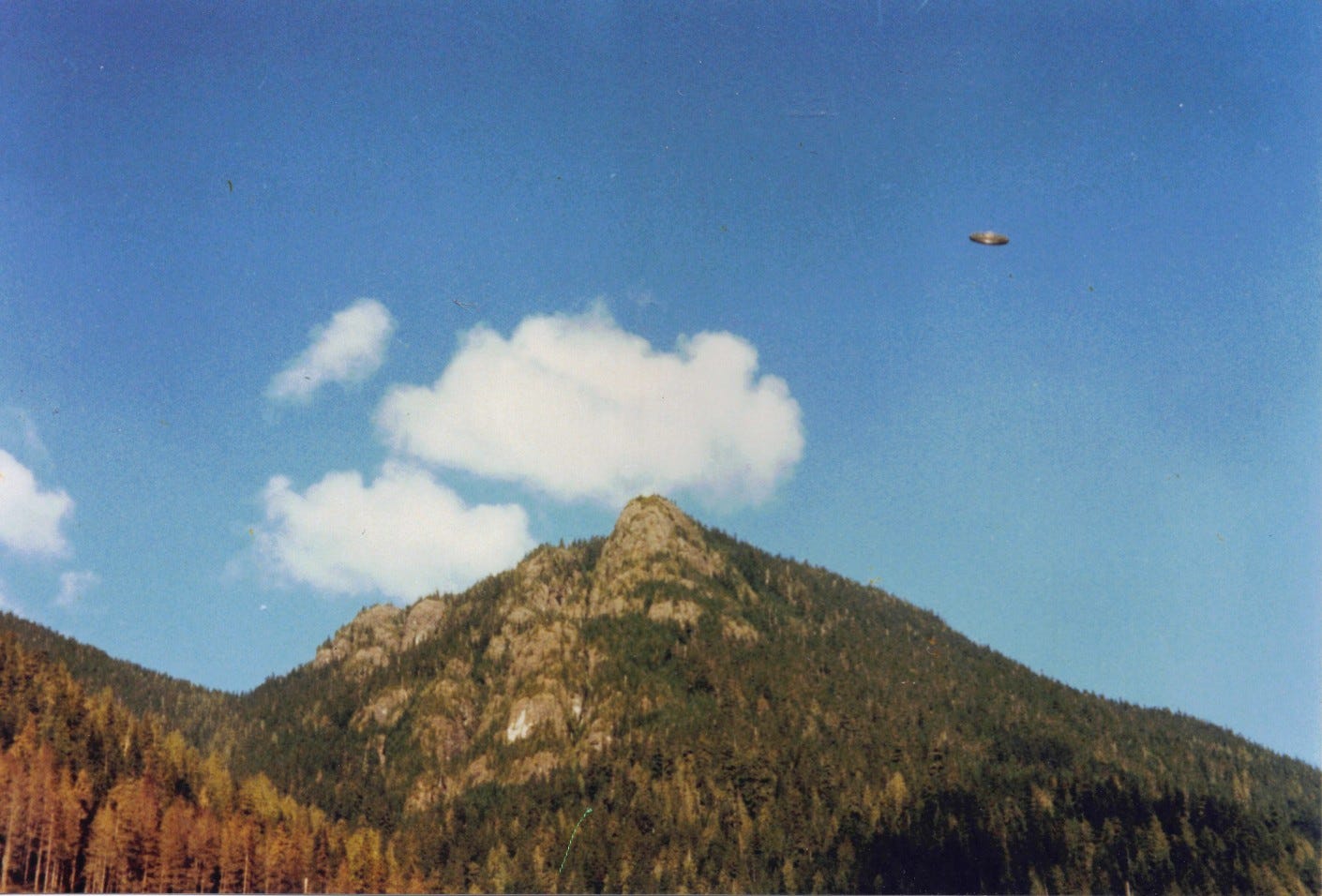
From Richard Haines’ 1994 presentation.
I heard about a case that took place in Campbell river right here. A couple had been on holiday with their 16-month old daughter and they were driving up to her sister’s house at the north end right up in here. And on the way they stopped at a provincial park to stretch their legs let the dog run. So they’re about halfway up and they take… she has a Mamiya 35 millimeter camera and takes a picture of her husband and little daughter beside a lake, then she stands up she said to me… turned around and saw this mountain. And this cloud on the top reminded her of a volcano so she said to herself, I’m going to take a picture. It’s kind of my personal volcano and I’m going to prove to my husband I can do a good job of photography. He’d been kidding her she couldn’t take a good picture well. As you can tell she took a very good picture and in fact she captured something in the sky that nobody that day saw.
It it took two weeks for the prints to come back and there it was on the print. It was circulated around the neighborhood for maybe a week. It went into a drawer, or actually a shoe box in the closet and forgotten and I saw the picture about two years later got interested in it and did some study on it. My hypothesis is it was a frisbee and the husband was playing a hoax and he taped a little dome on the top and threw it up, and she took a bunch of pictures and submitted it. Okay well first of all they have made no money on this photograph, they waited two years- I have the original negs [negatives] and it’s the only frame on the whole roll with this picture on it. So they did a pretty good job by chance and so forth. She said her narrative is that she’s focusing on the tip of the mountain and sure enough that’s where the mountain is near the center of the frame. If i were going to do a hoax like this I’d focus probably or aim it at the object itself although that’s inconclusive. That’s maybe a very carefully contrived hoax and so any photograph that you have for analysis is only as good as the photographer and their motives and training, the camera the lens the film the processing the story that surrounds it on and on.
On initial inspection, the UFO doesn't look like anything immediately recognizable. The next logical step is to test the hypothesis of an ordinary object.
Haines’ investigation collected testimony from the photographer and her husband and established a timeline around the event. No evidence was found that supported a hypothesis of tampered film or a string to support the object in the air. Haines also tested the hypothesis that the disc was a frisbee.
It is highly unlikely that the object photographed was a commercially available Frisbee. There are significant top surface contour differences between a Frisbee and the photographed disc. This was shown by a careful comparison of photographs of a Frisbee model with scale dome oriented the same as the photographed disc and illuminated by sunlight under the same angular conditions. The surface reflections were markedly different in each case. In addition, the presence of the tiny, concentric micro-grooves on all Frisbees would not be expected to yield a sharp contrast gradient as is seen in Figures 7(b), 8, and 9. When the author attached a light-weight dome to a Frisbee it would not fly very far nor very high. It is problematical whether another person could have achieved such a feat. The author inspected the frame immediately following the frame in question and found that it had been taken in Campbell River following the trip north. The immediately preceding frame was also located. It showed Mr. D.M. [the photographer’s husband] and their daughter standing in front of a small pond at the Provincial park on the day the photograph had been taken, exactly as stated by the photographer. If someone had tossed a model up into the air in order to photograph it, only one photo was taken. It is fortuitous that such a clearly focused image was obtained on the first try, if this is what happened.
Haines also tested for a double exposure.
A horizontal scan using the micro-densitometer also was made to see if there was any evidence of a double exposure. A double exposure might be indicated by the presence of double edges if the film registration is not precisely the same during a manual rewind. No such evidence was found. In addition, this camera could not take double exposures due to its frame locking mechanism.
The full investigation of the case shows the technical details of the camera, lens, exposure metrics, possible reflectivity of the object’s material, and geometry of the object’s relation to the camera.
Photographic negatives are a form of physical evidence. Light that is reflected or emitted from an object chemically changes the photosensitive crystals in the film stock, resulting in patterns of density that form the image. An object’s albedo, angular size, depth of field, shadow direction, and the area’s atmospheric conditions are all data.
As we know, a photo can only capture an object’s appearance, and therefore it cannot truly conclude what an anomalous object is. In most cases like this one, a photo can only suggest what the object isn’t. Here, the object was not any recognizable aircraft, flying or floating object, atmospheric phenomenon, flying animal, or hoax.
We are unfortunately at a dead end, since the photo and the investigation around it were the only data that showed the object to exist. If our hypothesis was that the object was an alien spacecraft, the photo would be circumstantial evidence, and weak evidence at that. A significant logical inference would need to be made to come to that conclusion.
Photo Analysis #2: The Lago de Cote Photo
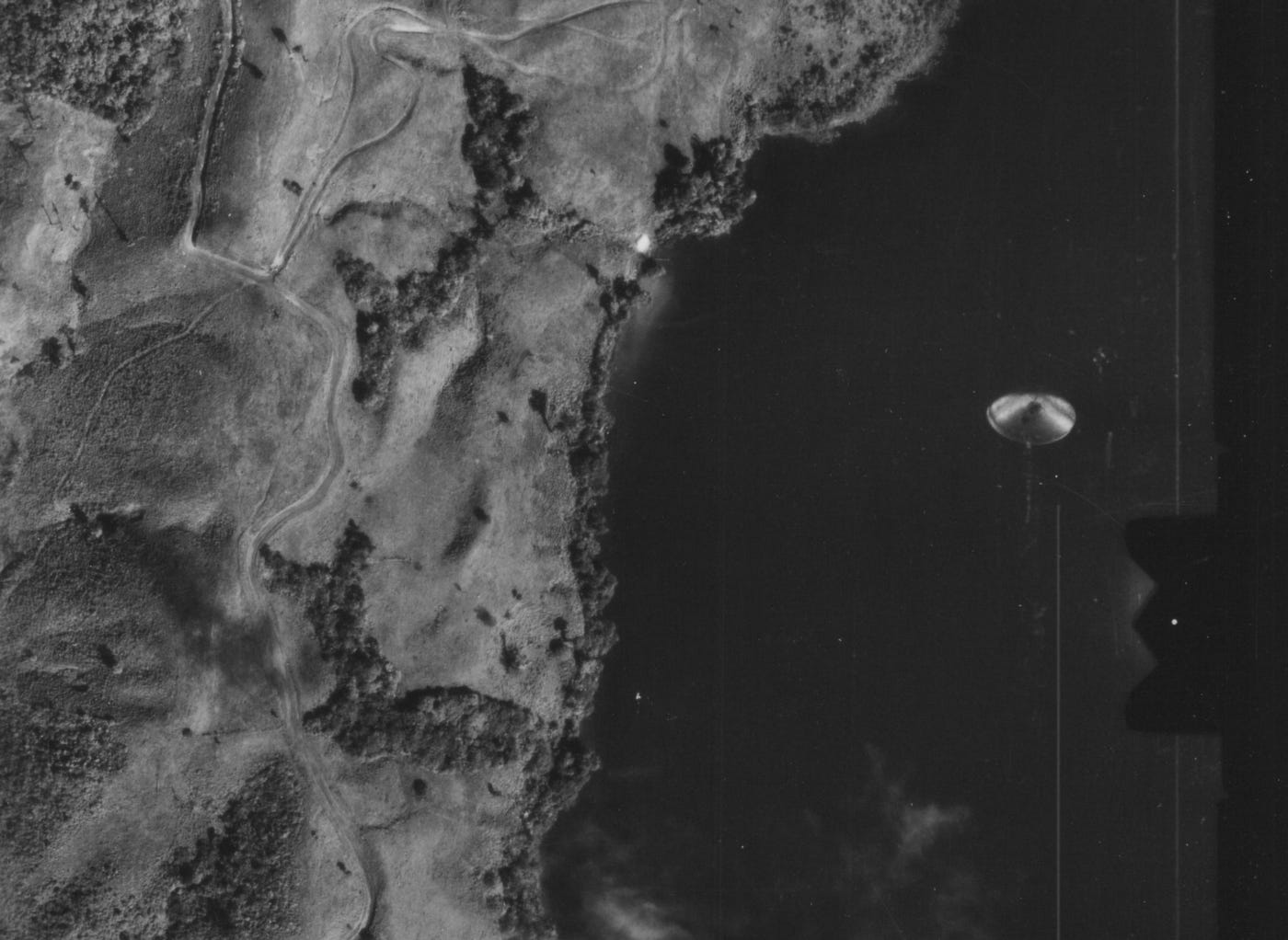
Our second photo is known as the 1971 Lago de Cote photo taken above the Costa Rican lake at 10,000 feet. The photo shows what appears to be a reflective metal disc above the water with an unknown size. Richard Haines also performed an investigation (linked here) on this photo along with help from famous UFO researcher Jacques Vallee. Note that this photo was a second generation negative, not the original. Normally the lack of an original negative is considered as weak evidence, but there was enough justification to do a full investigation, as described by Jacques Vallee.
In spite of the lack of a first-generation negative, we felt several unusual factors justified a detailed analysis of this photograph, if only to refine our methodology in dealing with such evidence: (1) it was taken by a high-quality professional camera; (2) the camera was looking down, which implies a maximum distance, hence a maximum size for the object; (3) the disc was seen against a reasonably uniform dark background of a body of water; and (4) the image was large, in focus and provided significant detail.
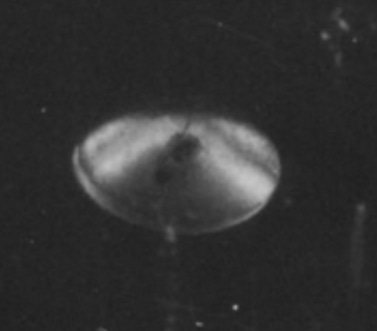
Below are some findings from their investigation of the photo, its contents, and circumstances of its exposure.
If the disc image was of a real object travelling at a high rate of speed relative to the film plane, then one would expect a blur on both the leading and the trailing edge. This did not occur here. The entire image is in sharp focus suggesting that the shutter speed was fast, and / or the disc was not moving relative to the earth background, or both. It is known that the exposure lasted 1/500 second which would "stop" a slowly moving object but not necessarily a fast one.
No ground shadow is seen. If the object was low enough altitude, a shadow wouldn’t be noticeable.
The disc is no farther than 10,000 feet away from the camera, as that would put the object at ground level. Given the metrics of the lens, film, and size of the object in the frame, if the object was at ground or water level, the object’s size would be 683 feet long.
Once again, the data rules out any known object, so what happens now?
The past two photos showed evidence that indicate an unidentified aerial or possibly water-floating object, plausibly made of solid material that reflects sunlight similar to smooth metal. In both cases, the objects were only visible to the camera for the moment of exposure, suggesting they were mobile and fast.
We have been exposed to the evidence.
We have evaluated and interpreted the evidence.
But how do we accept the evidence? Is it at all useful?a
No known object could have produced either photo, suggesting that both may be valuable discoveries for science.
Taking a step back, we might realize how weak photo evidence truly is. No single photo can reveal the origin of a UFO it is indeed exotic, just like a photo of a new species of jellyfish can tell us where it comes from, what it eats, or the duration of its life cycle. If we want to learn about jellyfish as it’s own species with it’s own full characteristics, then photos of their appearance are not nearly enough.
Authenticating UAP Imagery Today
With generative AI and image editors like photoshop in wide use today, photo evidence is more difficult to accept than ever. Image authentication is a critical step for photo evidence, but despite today’s potential for faked images, it still can be done.
Cameras convert the physical luminance of a scene to an electrical charge in a sensor, or chemical changes in film stock. Digital image editors only edit pixel color values, and film negative manipulations like double exposures have their own telltale marks. Today, the best generative AI models and artists cannot perfectly mimic physical depth of field, lens distortion, luminance, and the organic imperfections that come with capturing data on real hardware.
Of course, finding these marks inside an image requires graduate- level forensics expertise, and after all that scrutiny, the result is a confidence score of the image media itself, not the content it shows. For those of us who aren’t experts, the most practical way to determine an image’s authenticity is to see its metadata, chain of custody, and to evaluate the credibility of its publishers.
Material Evidence: The Council Bluffs Case
Material data is often considered the most valuable form of data for UAP. Solid fragments of material have been collected all over the world and studied in labs. But material analysis has its own difficulties of interpretation. Chain of custody remains critically important, and many material fragments often don’t show direct clues to object origin.
One case, known as the Council Bluffs case, happened in a park in Council Bluffs, Iowa in 1977. Police and firefighters responded to the incident and eleven witnesses independently observed the event.
Mike Moore and his wife Criss, reported seeing a hovering red object with lights as they crossed 16th street on their way downtown along Broadway avenue. Criss reported “a big round thing hovering in the sky below the tree tops. It was hovering. It wasn’t moving.” She added that she saw red lights around the perimeter of the object, blinking in sequence. A middle-aged couple who saw the event spoke to the investigators by telephone, stating that they had seen “a bright red object rocket to the ground near Big Lake” but refused to be identified. Four teenagers in a small foreign car spoke to the Drakes at the time of the incident but did not make a report. Secondary witnesses who observed the metal were Jack E. Moore, assistant fire chief (who took the 911 call from Kenny Drake), police officer Dennis Murphy and Robert E. Allen, who had served in the Air Force and wrote a weekly astronomy column for a local newspaper. Mr. Moore stated that the center of the metal mass was too hot to touch when he arrived on the scene about 8 p.m., only 15 minutes after the initial incident, and that it remained so for about an hour.
Quote from Jacques Vallee’s report from Physical Analyses in Ten Cases of Unexplained Aerial Objects with Material Samples published in the Journal of Scientific Exploration, 1998.
In the course of the investigation, four hypotheses were tested.
Hypothesis 1 : A hoax by pouring molten metal on the ground. The only company capable of maintaining molten metal in the metropolitan area does no pouring on weekends (the event happened on a Saturday). Transporting molten metal would have have to be done in a thick brick oven inside a large truck. Conclusion negative.
Hypothesis 2: Hoax by unknown person using thermite and ordinary metal. A check with chemical construction firms in the area found no traces of thermite in the material. Conclusion negative.
Hypothesis 3: Dropped piece of aircraft equipment. The site was not far from an airfield, but no abnormal aircraft activity was reported and no arrivals that would bring an aircraft into the vicinity at the time of impact. Conclusion negative
Hypothesis 4 : Meteoric impact. There was no significant crater and no elemental composition compatible with meteors. Meteors also don’t impact and stay molten for as long as this material did. Conclusion negative.
The slag-like metal was chemically studied and was found to be mostly iron with traces of chromium, manganese and silicon. No exotic materials were found, and the case remains unresolved today.
This video from Garry Nolan presents the Council Bluffs case along with details of it’s material composition.
Just like the photo cases, there is not much to go on. The appearance of molten metal along with the red light UAP is anomalous, but not attributable to anything exotic. Crossing that threshold would require more data.
By now we are starting to see the shortcomings of studying physical evidence of UAP. The evidence is anecdotal, and these kinds of UAP appearances are not predictable or reproduceable. If UAP have an exotic source, controlled laboratory experiments will eventually have to do be done. Reactive studies to scattered cases around the world will only get us so far.
Radar-Visual Evidence: 2004 Tic Tac UAP
If you are all the way here, you have probably heard of the “Tic Tac” case from 2004. If you haven’t, watch this and continue this article. The Tic Tac case kicked off today’s disclosure movement and has been extensively studied.
This 2019 study was done by the Scientific Coalition for UAP Studies, and it looks at the full timeline of observations of the event with a focus on the UFO’s motion. Data was used from the recorded video, radar data, and eyewitness reports.
From the SCU publication Estimating Flight Characteristics of Anomalous Unidentified Aerial Vehicles.
As the F-18s approached merge plot, which is the point at which the radar could not differentiate the positions of the F-18s and the UAV, Fravor and Slaight noticed a disturbed patch of water, where it appeared as if there was a large object, possibly a downed aircraft, submerged 10 to 15 feet below the surface. As they observed the disturbance from 20,000 ft, all four pilots spotted a white UAV, shaped like a large cylindrical butane tank, or a Tic-Tac candy, moving erratically back and forth, almost like a bouncing ping-pong ball making instantaneous changes in direction without changing speed. The Tic-Tac UAV was estimated to be about the size of an F-18, about 40–50 feet in length and 10–15 feet wide, but had no apparent flight surfaces or means of propulsion, and its movement had no apparent effect on the ocean surface as one would expect from something like rotor wash from a helicopter.
Fravor started a descent to investigate while his wingman kept high cover. As Fravor circled and descended, the UAV appeared to take notice of him and rose to meet him. The F-18 and the UAV circled one another. When Fravor reached the nine o’clock position, he performed a maneuver to close the distance by cutting across the circle to the three o’clock position. As he did so, the Tic-Tac UAV accelerated across Fravor’s nose heading south. Fravor said that the UAV was gone within a second. As a comparison, Fravor noted that even a jet at Mach 3 takes 10 to 15 seconds to disappear from sight. LCDR Slaight described the UAV as accelerating as if it was “shot out of a rifle” and that it was out of sight in a split second.
When this story came out, I heard many skeptical reactions that attempted to explain possible conclusions for these events. People explained how pilots could be mistaken about seeing things in the sky. Pilots are human, and humans are fallible sensors after all. But this is a lazy conclusion on which to land. Pilots are trained to identify aerial objects for their own safety, and they have many sophisticated channels to do it. If we discount the witness reports from multiple sources, we are actively throwing away valuable data and restricting ourselves from a potentially useful hypothesis.
If the Tic Tac UFO was controlled by something non-human, then motion data and witness testimony alone will not tell us much. The main takeaway from the publicization of this case was that the phenomenon was not only real, it was capable of doing things thought to be impossible.
In recognizing the impossibility of the motion, a second hypothesis was considered at the end of the study.
In this paper, we have worked under the assumption that these UAPs were physical craft as described by the pilots. The fact that these UAPs exhibited astonishing flight characteristics leaves one searching for other possible explanations. One very clever explanation suggested by one of the reviewers was that these UAPs could have been generated by the intersection of two or more laser or maser beams ionizing the air, which could create a visual image, an infrared image, as well as a radar reflective region possibly explaining much of the observations.
While such an explanation could explain the visual, infrared and radar observations, it would not be able to explain either the suborbital radar returns from the ballistic missile defense (BMD) radar systems on the Princeton before the UAPs dropped to 80,000ft, or the sonar returns when the TicTac UAPs went into the ocean, both of which are not as well substantiated or documented as the other observations.
More importantly, the distribution of the UAPs ranged from over 100 miles to the north over Catalina Island to about 70 miles to the west. This would require an array of widely distributed and coordinated lasers situated on multiple ships or aircraft. However, it is known that there were no other ships or airplanes in the area. In addition, the fact that the UAP reacted to CDR Fravor’s maneuvers would require that radar be used to track the F-18s so that the laser-produced imagery could react to them. However, any such radar frequencies being used in the area would have been detected by the Princeton, the E-2 Hawkeye, and the F-18s themselves.
For reference, I had no idea that lasers and masers that could affect radar data. I also didn’t know what a maser was until I looked it up after this article (apparently it’s like laser but uses microwave radiation instead of visible light).
And there’s a point to be learned here. If the scientists of the study didn’t know about the possible laser / maser explanation, they would be even further in the dark than they already are. This situation is a small example of the intersection of advanced terrestrial technology and UAP. Without knowledge of these potentially classified systems, any hypothesis of UAP can be that they are evidence of classified manmade technology. The implication would then mean that data on these objects can be held secret under ordinary classification law. In other words, classification would directly hold back scientific hypotheses from being tested. This is yet another specter that looms over the topic and something that I’ll describe more later.
Witness Evidence of UAP
Even if our interest is in the study of UFO's as some sort of extraordinary physical phenomenon (whether of natural or, possibly, of intelligent, extra- terrestrial origin), our study cannot ignore the inescapable fact that nearly all of our evidence comes—not from physical measuring instruments—but from human observers. So far, however, we have consistently sold the human observer short.
- Roger N. Shepard, Department of Psychology, Stanford, in his statement to the the House of Representatives Committee on Science and Astronautics in 1968.
Humans are imperfect sensors. Witnesses can misrepresent the truth for any number of reasons. They bring bias and some even fabricate hoaxes. Other times they serve as many sensors at once, and they gather valuable data such as what UAP look like, sound like, along with descriptions of the circumstances of the event.
As we saw with the photographs, the data is only as valid as its collector, and with witness reports, the report is only as good as the witness’s credibility. This fact has been weaponized against witnesses for as long as the phenomena has been reported, and it has made the truth harder to reach.
In J. Allen Hynek’s The UFO Experience: A Scientific Inquiry (1972), Hynek puts to bed a list of misconceptions about witnesses who report UFOs. The book is a great resource for recognizing the shortcomings of how we see the topic even today. One of the most significant conclusions Hynek found was that there was no direct correlation between the strangeness of UFO reports and witness credibility. One might assume that the strangest cases have the lowest witness credibility, but that’s not what the studies showed.
While Hynek doesn’t spend much time on the topic of non-human intelligence, (which he mostly addresses as Close Encounters of the Third Kind- cases in which the witness observes “UFO occupants”) I would go out on a limb here and suppose that the only direct evidence we know about non-human intelligence has come from human witnesses. No mechanical sensor can detect intelligence the way a human can. If this is generally true, we might be in a position where our most deniable sensors are the only ones that can detect direct evidence of NHI.
Human Physical Evidence
One of the difficulties of using witness reports is that people often see things that are entirely new to them. They are limited to describe their observations with the language they already know. A natural communication barrier arises.
But one form of witness evidence comes not just from recalled experience, but from their physiological conditions. Some experiencers are left with trace evidence on their bodies in addition to their observations. In a slightly morbid situation, these witnesses can let their injuries speak for themselves.
Human Physical Evidence: Cash-Landrum Case
The case known as the Cash-Landrum incident is one of the best recorded cases of human physiological effects resulting immediately from a UAP encounter. The case involved two women- Betty Cash and Vicky Landrum, and Landrum’s seven year-old grandson Colby.
Dayton, Texas, December 29, 1980.
Cash, Landrum, and Colby were driving when they saw a UFO in the sky ahead of them.
According to their reports, they encountered a large, diamond shaped object hovering above the road in front of them. Flames were belching from the bottom of the craft. The interior of the car became hot, forcing them to leave the vehicle. In spite of the heat, Colby and Landrum returned to the vehicle out of fear. Cash remained outside the automobile for seven to ten minutes. The object rose into the night sky and moved away. According to their reports, the object was accompanied by twenty-three helicopters that Cash and Landrum assumed to be military.
Schuessler listed the following medical problems developed by the three witnesses: swollen, painful, and watery eyes; permanent damage to the eyes; stomach pains, vomiting and diarrhea; sores and scarring of skin, with loss of pigmentation; excessive hair loss over a several-week period, with the new hair having a different texture than the old; loss of appetite, energy, and weight; damage to fingernails and shedding of fingernails, increased susceptibility to disease; and cancer.
…
The available evidence (which is admittedly sparse) seems to be indicative of microwave, infrared, visible, and ultraviolet radiation, although a few cases seem to point toward high doses of ionizing radiation, such as X rays or gamma rays.
The case is described in detail in John Schuessler’s book The Cash-Landrum UFO Incident (1998), and is referenced in many other publications and documentaries.
Human Physical Evidence: AAWSAP Case: Ron Becker
This next report comes from a case study report from AAWSAP. This is the Advanced Aerospace Weapon System Applications Program- the US government’s official UAP program managed by the Defense Intelligence Agency that was active from 2009-2010.
The following are quotes from the AAWSAP program manager James Lacatski’s 2026 book Inside the Government Covert UFO Program: Future Visions.
May 1, 2005. Forty-eight year old biotechnologist Ron Becker (using an alias for privacy reasons) and his daughter were driving 50 miles southeast of Bend, Oregon.
Becker’s daughter was in the passenger’s seat back in the reclined position when she noticed three bright blue objects flying about a hundred yards away in a nearby field. The objects were making random zig-zags around each other with no apparent purpose. As the younger Becker watched in puzzlement, the three blue orbs moved quickly toward their car. Within seconds, two small round objects flew directly through the vehicle. One passed across the dashboard in front of the father and daughter before exiting the car through the window. As the younger Becker watched in horror, the second orb entered the upper left arm of the father, passed through his upper body at chest level, and exited his body at the level of his bicep.
The daughter witnessed the blue orb enter and exit her father’s body, and her father later recalled his daughter’s expression of fear as he felt discomfort the moment the orb entered his body. Ron Becker saw the blue orb after it had exited the car, and he described it as softball-sized with clear outlines.
Becker immediately felt unwell while driving the remainder of his trip. He suffered a rash, hair loss and impaired vision and hearing, all on the left side of his head. Many more serious effects happened over the next two years that are recorded in the report that are too long to write here.
His most serious medical complaint was a diagnosis of ductal carcinoma in situ DCIS in his left chest in February 2007. Although extremely rare in men, Becker’s physician was sure of the diagnosis. He underwent surgery on May 14, 2007. A biopsy of his lymph nodes indicated that the cancer had not metastasized.
…
Becker’s case was one of history’s most thoroughly documented encounters with an anomaly. Dozens of separate blood parameter measurements were taken before and after the May 1, 2005, event. This comprehensive medical documentation allowed BAASS to make definitive statements regarding the patient’s blood chemistry. There was a dramatic change in his white blood cell counts following the incident. His lymphocyte count progressively decreased, while his neutrophil count progressively increased over the two years following the incident. Neither type of blood cell showed signs of returning to normal levels, even two years after the blue orb incident.
…
From a general perspective, multiple questions surround this case, the most obvious being, “Is there a cause-and-effect relationship between the 2005 incident and the dramatic change in this man’s health?
If these cases leave you with more questions then answers, then what you are feeling is normal. Physical effects of UAP exposure are rare but important parts of the phenomenon. There far more cases like these that have been reported all over the world, and more are reported in Lacatski’s book Future Visions.
So what have we learned? We have been exposed to health effects of some UAP cases. We can imagine how valuable it would be to the victims to have answers for their experiences, not to mention how valuable it would be for their physicians and caregivers.
As we know with criminal cases, not all victims report their experiences, and not all witnesses report their full story to authorities or places where they can be recorded. In many cases described in Hynek’s The UFO Experience, witnesses sometimes leave out the strangest parts of their report when telling journalists, police, and others. Their full story only comes out when they feel secure enough to share it.
There is a sense of vulnerability and a powerful emotional narrative here, and it manifests today with the narratives of whistleblowers who put themselves in public view and risk their jobs to report the wrongdoing of enforced secrecy. This process has been on full display since 2023 when former intelligence official David Grusch testified to congress about his knowledge of classified government UAP programs and the retaliation he faced since.
Human emotional value aside, these narratives are a powerful tool to spread awareness of UAP, and they work in tandem with the threat narrative spread by Lue Elizondo.
Public UAP Reporting and Databases
While the cases described in this article are anecdotal, UAP reports are far more common than you might think. The sheer volume of reports is still staggering and thousands of observations are reported every year. I’m including these reporting centers and databases as a list of links and short descriptions with how to use and browse them.
CUFOs.org- Non-profit started by J. Allen Hynek. Contains many resources including UFOs and Intelligence timeline- a current record of UAP events that intersect with military and civilian organized secrecy
ufo-search.com- a minimalist design site which includes a thorough timeline of UFO and related cases built from evidence collections and indexed newspaper records. Just for fun- I recommend entering your current city or hometown and seeing what cases and reports show up.
NUFORC- National UFO Reporting Center- Non-profit reporting center that has processed over 180,000 reports and been active for over 50 years. Sort by Tier One reports and view the Image Gallery for witness photos, videos, and illustrations. Images are linked with their corresponding case reports.
UFOSINT Explorer- UFO open-source intelligence dashboard searchable with date and location with over 600,000 reports. It was created by a mod from r/UFOs who was disappointed with the numerous vibe-coded UFO databases online (there are many). UFOSINT includes databases UFOCAT, MUFON, NUFORC, and ufo-search.com.

Moongraph.io- Not just a database, but a document intelligence network built to parse all sorts of media, extract and visualize knowledge, and explore connections. While not yet publicly accessible, this is a LLM-assisted network of UAP and related political, military, and international history.
How to Perpetuate a Mystery
Given all that I’ve talked about here, we might ask- if these events have all happened as described, then what are we waiting for? Why aren’t government labs working on this problem all the time? If there are forces out there, or really, here on Earth that can outmaneuver jets and cause cancer and disappear without a trace, why is this not a bigger deal?
The short answer as I understand it is a combination of factors.
The phenomenon is likely incredibly more diverse than we realize. We’re not talking about a few physical phenomena or a few new intelligent species. Instead we are possibly talking about an ocean’s worth of flora and fauna. Imagine diving into the Pacific, and after a few hours we conclude that everything that moves must be a fish. Our media applies the same simplistic view on UAP because we make generalizations about the whole instead of focusing and drawing inferences from individual cases. We need better language and better methods of communication. Both are things that can emerge with better science.
The second part is that the most compelling and direct evidence is likely classified. Scientists and the intelligence community know that the most irrefutable evidence of UAP or NHI would be solid material, (liquid, gas, or plasma would not be as easy to collect for study). Craft material and alien bodies would be top priority to hide.
The third part is that are multiple disinformation operations in effect. There are thousands of far more extraordinary UAP cases that I haven’t touched on because their sources are made to be perceived as more controversial. Unpacking the stigma is necessary , but it is outside the scope of this article. Both the real phenomenon and hoaxes can exist at the same time, and I believe they do.
So that’s what we are left with. Limited reports of the recorded phenomena, an active professional disinformation campaign, and the history of hiding evidence. When combined all together, any single case becomes plausibly deniable, at least when viewed on the surface. Discrediting the witnesses and citing human error is all one needs to do to sweep the issue under the rug, and reject the value proposition of UAP.
At the End of the Day
What counts as acceptable evidence? Is it “enough” to read about cases in a book? A Substack article? Or a scientists’ peer reviewed research publication? Or do we have to be in the laboratory with the live alien, seeing it with our own eyes? We all have our own subjective standards of proof for different things, and that’s normal. But I think for most people, the topic is not truly about the science. Instead it’s about value. What does it mean to us, if any of this is real?
I’ll close with one dramatic example that summarizes the situation we’ve seen. Here, the UAP value proposition is met with hostility at worst, and apathy at best, despite the evidence provided. Listen to this video of Ronald Moultrie from 2022, who at the time was the Undersecretary of Defense for Intelligence and Security, and the man whose signature established the All-Domain Anomaly Resolution Office. This clip is from the first UFO hearing since 1968, and Moultrie’s back and forth with Representative Mike Gallagher says a lot.
It would be one thing to not know about the Malmstrom incident that representative Gallagher referred to. But to reject the importance of the alleged case in such a way was a rejection of the value of the topic as a whole. At risk of reading too much into this exchange, we might suspect that the US government- at least Bray, the Deputy Director for the Office of Naval Intelligence, and Moultrie and his All-Domain Anomaly Resolution Office- might not reflect the value proposition of UAP studies that Gallagher seemed to share. Moultrie retired from government service in 2024 after an extensive career in senior national intelligence roles. In the same year, Gallagher began work at Palantir as “Head of Defense Business”.
There is a lot to unpack about the way UAP is talked about in government, and the topic is quickly becoming political. The Task Force for Declassification of Federal Secrets- a Republican-led subcommittee that held the latest hearing on UAP- is aiming to deliver the subject to president Trump in hopes he will declassify what the government knows about UAP via executive order. Personally, I cannot think of a worse form of disclosure.
In my possibly naive opinion, a much more constructive form would be a long process of open civilian science, where data is shared without classification, and business models that incentivize secrecy are recognized and regulated by international agreements. People would need time to acclimate their worldviews if NHI is revealed to exist near Earth, and a single announcement that reveals too much might be too disruptive and manipulative.
The good news is that at the end of the day, the politics are not anomalous. We know how humans act. Power dynamics are not new. Citizens still have power in the United States, and what matters is what they fight for with their limited means.
One of the goals of science is building consensus, and scientists are human beings with values, bias, and personal interests. The data show that there is increasing agreement that UAP studies are indeed valuable, if for nothing else than that solving anomalies benefits our understanding of reality.
“A new scientific truth does not triumph by convincing its opponents and making them see the light, but rather because the opponents eventually die and a new generation grows up that is familiar with it. New phenomena emerge from an awareness of an anomaly, the gradual emergence of both observational and conceptual recognition, and the change of paradigm categories in the face of resistance.”
-Max Planck
If you made it all the way here, thank you so much for reading! UAP Status is a labor of love and your support helps me parse the most coherent parts of the topic for new eyes and ears. Check out my YouTube and Instagram channels- both called UAP Status. They are a collection of the most coherent and interesting clips from four years of congressional hearings about UAP and government secrecy. It’s scrollable like TikTok, and it’s exposure to the credibility of the topic. Perfect for introducing it to new people in your life. UAP Status on Instagram and Youtube. Thank you for listening, and supporting UAP Status. Until next time.