

Why This One is Different
Go on any streaming service and type in UFO. Dozens of saucers, aliens, stargates, and pyramids line up and beg for attention. What if there was a trusted, authoritative source you could find about UFOs and UAP, Unidentified Anomalous Phenomena? You’re a discerning viewer with limited time. You’re going to watch the latest, greatest, glossiest, trusted source. It’s got Secretary of State and National Security Advisor Marco Rubio talking about UFOs! It’s bipartisan!
Okay, maybe you don’t know any of that and maybe it’s just getting pushed to the top of your feed.

Thanks, Amazon Prime Video.
The difference here is that The Age of Disclosure is receiving marketing for a mainstream audience. The film premiered at SXSW and its director Dan Farah is interviewed in Hollywood publications like EW, Variety, and appearing on Fox News, CNN, Joe Rogan, and even on Real Time with Bill Maher.
The Age of Disclosure is the culmination of years of UFO revelations from whistleblowers, US Air Force and Navy pilots, and other officials. It wants to grab your attention with credible sources as well as a deep state conspiracy described here as “The Legacy Program”, an ever-changing group that holds secrets about recovered UFOs, alien bodies, and reverse-engineered exotic technology .
Our guide through these rabbit holes is Luis Elizondo, a former DOD intelligence officer who worked on the Advanced Aerospace Threat Identification Program, an agency that investigates UAP reports around the world through the lens of a national security threat. This is largely the same lens that the film uses, and on the surface it is remarkably compelling. Elizondo is crystal clear in his message.
“Based on hard evidence and data, we learned that UAPs present serious national security concerns and a potential existential threat. Simply put, transmedium crafts, vehicles that have the capability to operate in space, air, and water and seemingly defy all that humanity knows about physics, have been operating with complete impunity around the world since at least the 1940s.”
Clips from drone sensors and other aircraft cameras show small round objects flying around the sky, the ocean, over buildings, etc.
“At AATIP, we had access to some of the most sensitive videos in the Department of Defense inventory. If you could be in my shoes and see what I’ve seen, and folks like Jay Stratton, there would be zero shadow of a doubt that these things are real and not made by humans”.
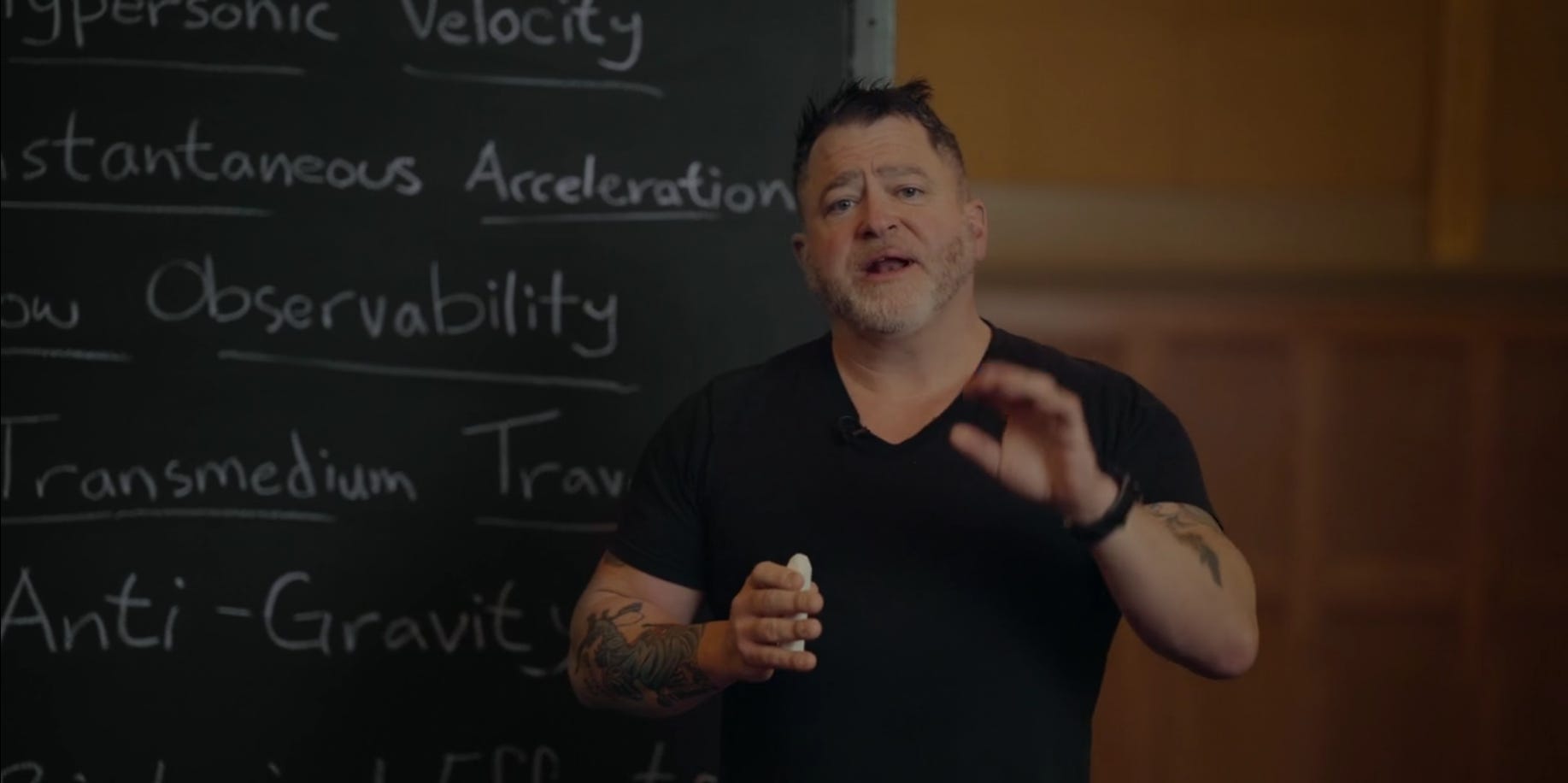
Elizondo describes the five “Observables” that are signatures of UAP.
There is a serious dissonance coming from the top of government. B-roll of government officials with worried looks walk around the capitol building and other landmarks. “Why isn’t the government taking this seriously?” asks the government. Elizondo and his colleagues are underdogs, and he plays the part well. He shows the cognitive dissonance of “I want to talk about something that I am not legally allowed to”. UAP are clearly something that needs investigating with transparency to the public, yet investigative efforts are stopped and results are classified. This feeling should be familiar to anyone who listens to today’s news about the AI bubble, the Epstein files, and so much more at this point.
But there is another source of dissonance, this time for the viewer. With claims of crash retrievals and alien bodies, this documentary must have some crazy footage right? Where are the scene recreations that make UFO docs watchable to a modern, social media-soaked audience? The Age of Disclosure is dry as a bone here. There are some animated sequences of saucers floating over ICBM silos, but not much more.
In its effort to legitimize the topic, The Age of Disclosure has traded spectacle for pure authority and credibility. This is likely for the audience that has absorbed the stigma built around the topic, and now rejects the clickbait. No big-eyed gray aliens or pyramids here. Only Congressional offices, courtyards, and hallways. Is this how to legitimize aliens? By not showing them? Where have we (not) seen this before?
The National Security Threat Narrative
It’s October 2002, and George W. Bush is outlining the threat from a supposedly WMD- armed Iraq.
By its past and present actions, by its technological capabilities, by the merciless nature of its regime, Iraq is unique. As a former chief weapons inspector of the U.N. has said, “The fundamental problem with Iraq remains the nature of the regime, itself. Saddam Hussein is a homicidal dictator who is addicted to weapons of mass destruction.”
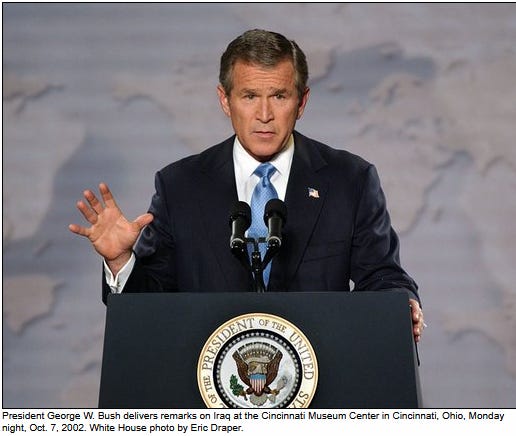
There’s nothing quite like describing someone else’s capabilities to motivate building your own.
In this speech, George W. Bush cited satellite surveillance and scientific intelligence sources that suggested an Iraqi nuclear weapons capability, and the need to act against it. Years later, we know that no WMDs were found during that period, yet the “evidence” was good enough for the administration to motivate an invasion.
A national security threat creates a certain gravity that no one escape. While propaganda is more of a linear force pushing a population towards an opinion, a NATSEC threat narrative aligns and pulls all concerns into one bottomless pit. The NATSEC threat builds a perception that the enemy is everywhere, all powerful, and you are not powerful enough to defend yourself today. The same concept not only sells jets and missiles to the military, it also sells cars and makeup. You’re never good enough.
The national security argument is the black hole of public persuasion. Not even free energy can escape.
Is this what The Age of Disclosure is doing? In other interviews, Elizondo describes a threat as a combination of capability and intent. The film shows that UAP clearly have capability beyond the best systems of the US Air Force, but intent isn’t yet determined. The question may seem silly, but we know the US has defense contractors that sell asymmetric advantage and strategic surprise as their bread and butter. Secrecy is a valuable currency, and the public are always the last to know.
Why does the film clearly omit the name of Lockheed Martin and instead use a placeholder? Other agencies get to proudly show off their seals. Why isn’t our NATSEC darling getting to show off too? Are we not yet ready to talk about the Palantir in the room?
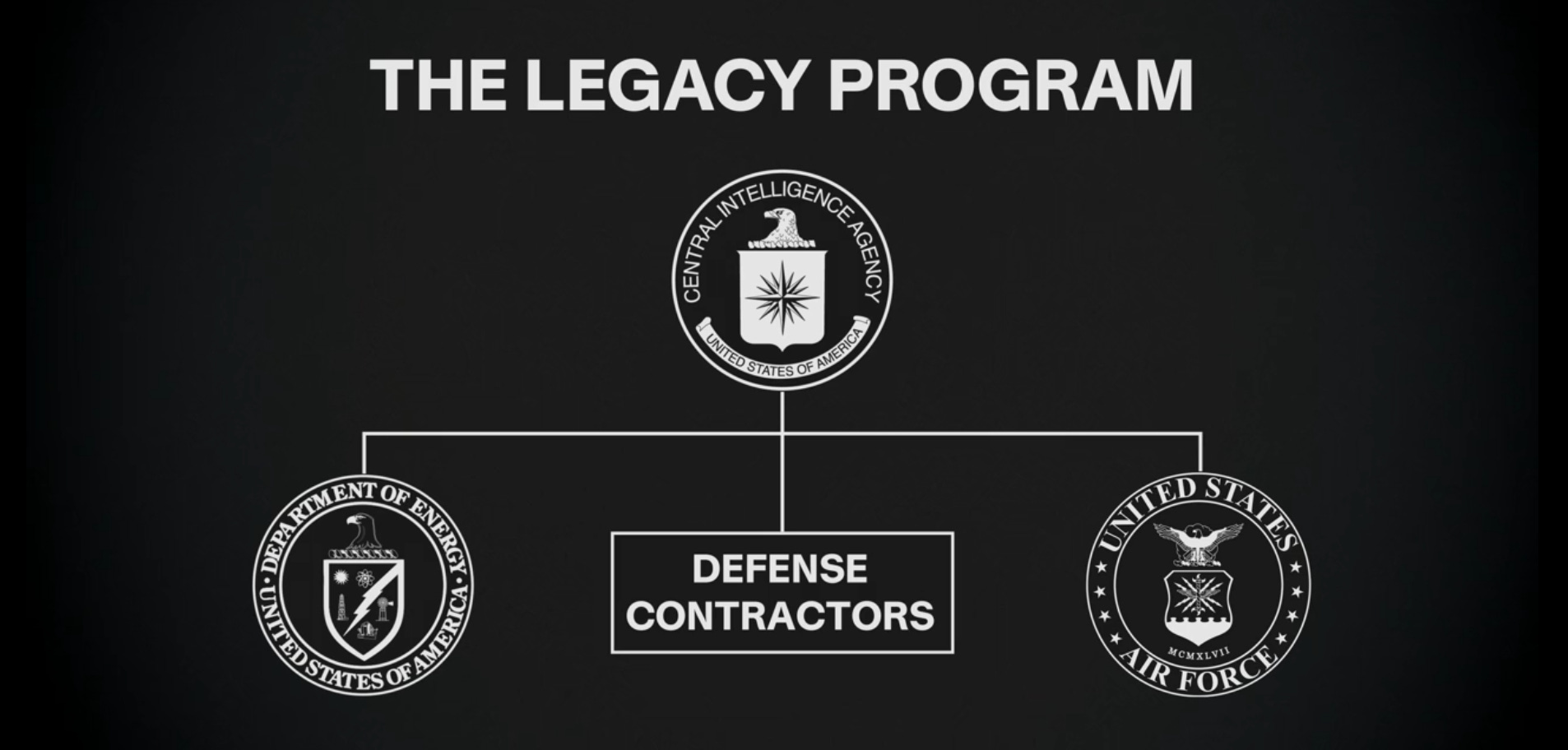
Another still from the film. Lockheed Martin Skunkworks has major connections to exotic tech and UFO crash retrievals, yet they are never mentioned by name in the film.
Should you Watch The Age of Disclosure?
The Age of Disclosure is a movie for the UFO-agnostic viewer as well as the UFO-curious viewer, and it presents a baseline of legitimacy to the topic. While it’s sparse on case evidence, it gains credibility from high ranking government talking heads, and it doesn’t fall into the same stigma traps that other media do. There are no alien faces that subconsciously signal the viewer to scroll past. That being said, the claims are extraordinary, and I guarantee if you haven’t been following the topic, you will be surprised by what is mentioned to Congress under oath.
If you are following the development of the Epstein story, the AI bubble, and the messaging around both, this film might be for you. Look at its messaging, look at what the interviews say vs what they show and the discrepancies between them. UAP have the potential to be another pillar of conspiracy equal to the Epstein files cover up. As someone who has closely followed the sworn testimony of credible witnesses in four intelligence and oversight committee hearings on UAP, I personally think there is a lot of truth in the subject, and it is absolutely relevant today. The UAP threat narrative has the potential to be compelling to both TV news consumers and even those of us with less trust in government. Here, the US government plays both the hero and the villain, a dynamic that no doubt helped elect our current president.
I believe the film’s overall message is weak, but it will linger as a baseline for viewers to compare to in the future. Why else would we have a highly marketed, heavily government-voiced documentary about UFOs?