

The date is September 14, 2023.
After nine months, NASA’s Unidentified Anomalous Phenomena Independent Study Report has concluded. Their objective was to examine the current state of UAP data collection, and to provide a roadmap for contributing to AARO’s mission of resolving UAP.


NASA Administrator Bill Nelson and three other NASA leads are seated at the panel and taking questions from the public. Film director James Fox is first in line and asks two questions. His question is a response to NASA and AARO’s assertion that there is no evidence that UAP are extraterrestrial in origin.
Thank you very much, this is directed to Mr Nelson. Thank you for being here. Two quick questions. One is, how can we make the determination of what something isn’t when we don’t know what it is?
And B, after a careful review of the data if it’s determined that some, underline the word “some” 10 times, UFOs or UAP originate from non-human intelligence, what’s the plan to disclose that to the public?
Administrator Nelson:
Let me repeat what I said. I think it’s important that you hear this word for word. The NASA independent study team did not find any evidence that UAP have an extraterrestrial origin, but we don’t know what these UAP are. The mission of NASA is to find out the unknown. I’ve said several times in my comments here today that we, NASA, deal openly, and we will be transparent on this, and we’re trying to address the question of—there’s so much concern that there’s something locked up, classified, and that the American government is not being open. Well, we are the American government, and we are open, and we’re going to be open about this. We don’t—again, I’m going to repeat that statement—but we don’t know what these UAP are, but we’re going to try to find out. Thank you very much.James Fox:
And is there a plan in place, if it is determined that some of them represent or originate from a non-human intelligence, to tell the public? Is there a plan?
Administrator Nelson:
If we are what I said we intend to be, which is transparent, you bet your boots we will say that. And I’ve tried to set the table for you by telling you what I personally believe, in a universe that is so vast, that could there be a replication of life on Earth elsewhere, in another solar system, that is so big? Of course I believe that. The distances—it would have to be a very advanced civilization—the distances, you know, light years, hundreds of light years, billions of light years. But whatever we find, we’re going to tell you. Thank you very much.
Let’s clarify the question and answer.
Fox is asking if NASA will be forthcoming about UAP if they are intelligent.
Nelson responds by asserting NASA’s mission of finding out the unknown, and being transparent. He then frames the possibility of non-human intelligence as being extraterrestrial, for example, as a civilization billions of light years away.
Fox is no stranger to the topic. He’s directed some of the best documentaries on the subject for almost 20 years. He’s interviewed hundreds of people willing and unwilling to talk about their experiences with UAP all over the world. In his film Moment of Contact, Fox traces the events that happened in 1996 in Varginha Brazil, in which three girls saw a large-eyed hominid creature soon after a UFO crashed near the city, and a police officer died days after grabbing and transporting it to a hospital. He’s familiar with the subject, the stigma, and the measures to maintain secrecy around it.
Fox was asking if NASA would disclose the origin of UAP if they knew it. Nelson asserted that NASA is transparent, and that the conversation is about extraterrestrials.
Extraterrestrial vs Non-Human Intelligence
Below is a quote from the UAP Disclosure Act, an amendment to the National Defense Authorization Act of 2023. The quote defines non-human intelligence as well as technologies of unknown origin.
Non-human intelligence.--The term ``non-human intelligence’‘ means any sentient intelligent non-human lifeform regardless of nature or ultimate origin that may be presumed responsible for unidentified anomalous phenomena or of which the Federal Government has become aware.
Technologies of unknown origin.--The term ``technologies of unknown origin’‘ means any materials or meta-materials, ejecta, crash debris, mechanisms, machinery, equipment, assemblies or sub-assemblies, engineering models or processes, damaged or intact aerospace vehicles, and damaged or intact ocean-surface and undersea craft associated with unidentified anomalous phenomena or incorporating science and technology that lacks prosaic attribution or known means of human manufacture.
Since we are keeping track:
The UAPDA of 2023, 2024, and 2025 did not contain the word “extraterrestrial”.
Each year of the UAPDA asserts interest in lifeforms and technology regardless of origin, and have allocated funds and proposed policy for transparency for UAP study and disclosure.
NASA’s UAP independent study report does not use the phrase non-human intelligence. It only frames NHI as extraterrestrial.
Let’s look at the most damning part of the NASA UAP Report itself.
Science is a process that reveals reality rather than sculpts it—no matter how unsatisfying or confusing that reality might be. That includes the question of whether UAP have an extraterrestrial origin. There is an intellectual continuum between hypothesizing that faraway extraterrestrial civilizations might produce detectable technologies, and looking for those technologies closer to home. But in the search for life beyond Earth, extraterrestrial life itself must be the hypothesis of last resort—the answer we turn to only after ruling out all other possibilities. As Sherlock Holmes said, “Once you eliminate the impossible, whatever remains, no matter how improbable, must be the truth.”
These statements might seem reasonable on the surface, but here’s why they are absolutely not.
UAP can potentially redefine what is physically possible. Ruling out what is currently impossible is a surefire way to not learn anything new.
“Ruling out all other possibilities” would scientifically require the study to have full knowledge of everything on earth in the totality of earth’s history before it can prove an extraterrestrial hypothesis. Taking this route is worse than stupid, it is a waste of time, money, and a waste of NASA’s great minds.
NASA, by way of their independent study, have shot themselves in the foot by taking this route. Somehow, the UAPDA, an amendment to America’s defense budget, is on a better course towards the truth.
AARO and Near-Earth Stigma
In 2025, Dylan Borland testified about his experience with the All-Domain Anomaly Resolution Office, and recounts how they have framed the ET vs NHI issue.
When we have not identified the phenomenon, it would be silly at best, and misleading at worst to only characterize an exotic origin of UAP as extraterrestrial. The term itself carries cultural baggage, and enhances “near-Earth stigma”. Near- Earth stigma is the fascinating concept that scientists are only willing to study non- human intelligent life when it is outside of the solar system.
Astronomer Beatriz Villarroel has encountered this when attempting to have her research presented with SETI. Her talk at the 2024 Sol Symposium gives a fascinating look at near-Earth stigma.
Terrestrial Intelligence
Why, you might ask, is this issue of UAP origin so important? SETI, NASA, AARO, and our best official agencies are only willing to acknowledge intelligent life if it is from outside our solar system. Yet the overwhelming majority of UAP are reported inside Earth’s atmosphere. Many are reported as lights and objects seen under the ocean surface. The origin of UAP may not be strictly ET. Other hypotheses of non human intelligence include ultraterrestrials, which are described here in a paper by AAWSAP contractor Hal Puthoff.
In a nutshell, the ultraterrestrial model includes non-human intelligence recorded in ancient history, occult and paranormal phenomena, and advanced breakaway civilizations that live parallel to the known world and kept hidden through exotic technology.
NASA is an Intelligence Agency
Lets take a second look at James Fox’s question to NASA Administrator Nelson. What can we take away from their interaction? Did Nelson give a satisfying answer? Is there a precedent for an organization like NASA to lie about its discoveries?
If Nelson was holding discoveries from the public, he would assert that NASA is a transparent organization. If NASA was telling the truth, he would say the same thing. This is the situation we face.
Consider today, now that NASA (and several other agencies) have had their primary mission superseded from a presidential executive order.
The agencies and agency subdivisions set forth in section 2 of this order are hereby determined to have as a primary function intelligence, counterintelligence, investigative, or national security work.
Among the agencies are:
The following subdivisions of the National Oceanic and Atmospheric Administration:
(1) National Environmental Satellite, Data, and Information Service.
(2) National Weather Service.”; and
(c) Adding the following after section 1-419:
“1-420. The National Aeronautics and Space Administration.
1-421. The United States Agency for Global Media.”.
Link to the Executive Order from August 28, 2025
In contrast, here is NASA’s Vision and Mission from their 2022 Strategic Plan document from their website.
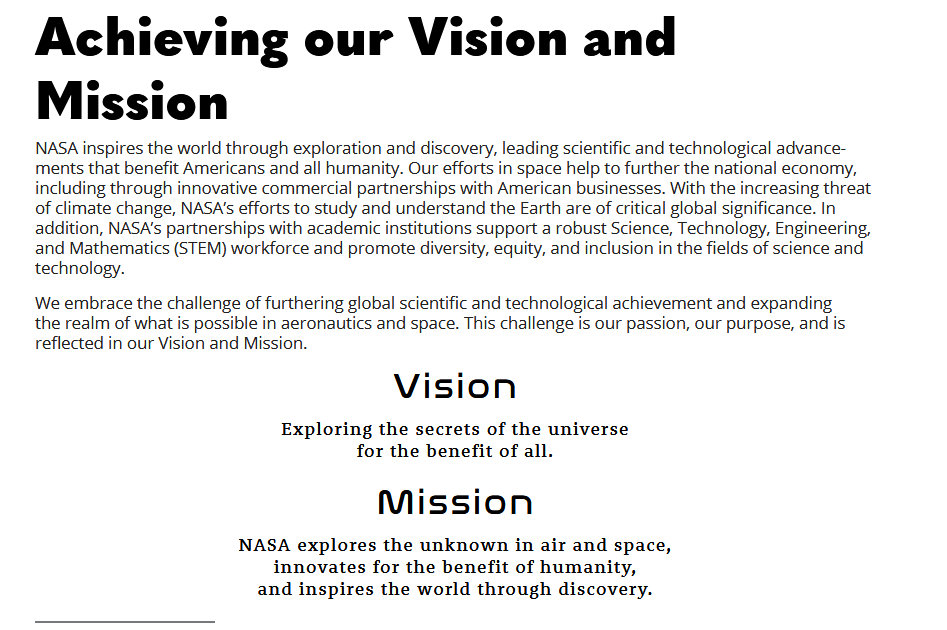
Now that NASA has an executive priority over its core mission of scientific exploration and innovation, does this increase, or decrease the likelihood that an administrator would tell the truth about UAP?
Nelson’s word should not be taken at face value- not because he represents NASA specifically, but because there is no incentive to honestly answer that question. Even if it’s not strictly classified, UAP revelations are explosive and would only invite more questions and scrutiny.
This being said, Fox’s questions are still important. By simply asking, he is checking the accountability of NASA, something that can only be done in a public setting. Holding power to account is something we can and should do, especially for such esteemed bodies like NASA.
I do not think NASA has suddenly turned against the public interest. I also do not think anyone should paint a massive and diverse organization like NASA with the broad brush of hate. NASA’s work is inspiring to millions of people and it’s a symbol of national pride. The space race of the 60s united the country in a powerful way, and today it has the power to put honest science and money towards studying exotic UAP, no matter what their origin might be. We can only hope that NASA and the current powers of the US can reject any further move towards politicized, non-scientific purposes.