

There is a common saying I hear when people talk about unidentified anomalous phenomena. It’s that no one really knows what UAP are. It’s a reassurance that brings people together and affirms that we’re all on the same side of the mystery.
While this is probably true, there are hundreds, if not thousands of people who know far more about UAP than we might think. These people, who I’ll call insiders, are not necessarily knowledgeable about UAP origins or their technical details. Instead, these insiders have knowledge about what actions have been taken in relation to UAP. Some of them, as I’ll mention later, watch UAP live on screens from classified video networks, and some build classification systems around what can and cannot be disclosed about UAP.
We know these insider groups exist because they have announced themselves willingly. The All-Domain Anomaly Resolution Office is one of the most recent ways the US government is managing the problem. Before AARO was established in 2022, there was the UAP Task Force, revealed in 2020, and before either of them were a word salad of working groups. Have they turned up any satisfactory information about the origins of UAP? If they had, would we even know?
It’s an uncontroversial take to feel that UAP cases should be investigated, and UAP origins should be understood. Yet government data specifically about UAP is classified.
But what does classifying UAP data actually mean? If UAP are not built by humans, then why classify them any more than a new atmospheric phenomenon, or a new species of marine life?
And going beyond the rules we have today, who benefits from such strict classification?
Unclassified Data
Anomalies exist. UAP exist in many forms across the world, in air, water, land, and space. UAP are photographed and measured on radar. They move against gravity, wind and human intention to get a better look. They interact with clouds, they leave marks on the ground, they irradiate human bodies, and they are seen at the same time as humanoid, yet non-human beings. This is the record of human observation across decades. So what are we doing about them?
Journalist Leslie Keane’s book UFOs: Generals, Pilots and Government Officials Go On the Record (2010) has descriptions of pilots being tasked to intercept UAP, as well as their direct reactions to what they encountered.
September 18, 1976, two F-4 Phantom IIs were scrambled to intercept a UFO flashing colored lights and changing shapes 6,000 feet above Tehran. Major Parviz Jafari attempted to fire an AIM-9 heat-seeking missile at this UFO but his firing systems malfunctioned, preventing the missile launch.
November 29, 1989, Wilfried de Brouwer was head of Air Operations of the Belgian Air Staff on a night in which 143 UAP sightings were reported in a small area around Eupen, Belgium. The Belgian Air Force scrambled F-16s, and in the following months, new protocols were enacted specifically for scrambling jets to intercept UAP.
1989 Belgian Wave
General Jafari and Major General de Brouwer were witnesses to UAP, and each took decisive actions following their observations. Their testimonies provide some of the best primary sources of information of how UAP appear and behave.
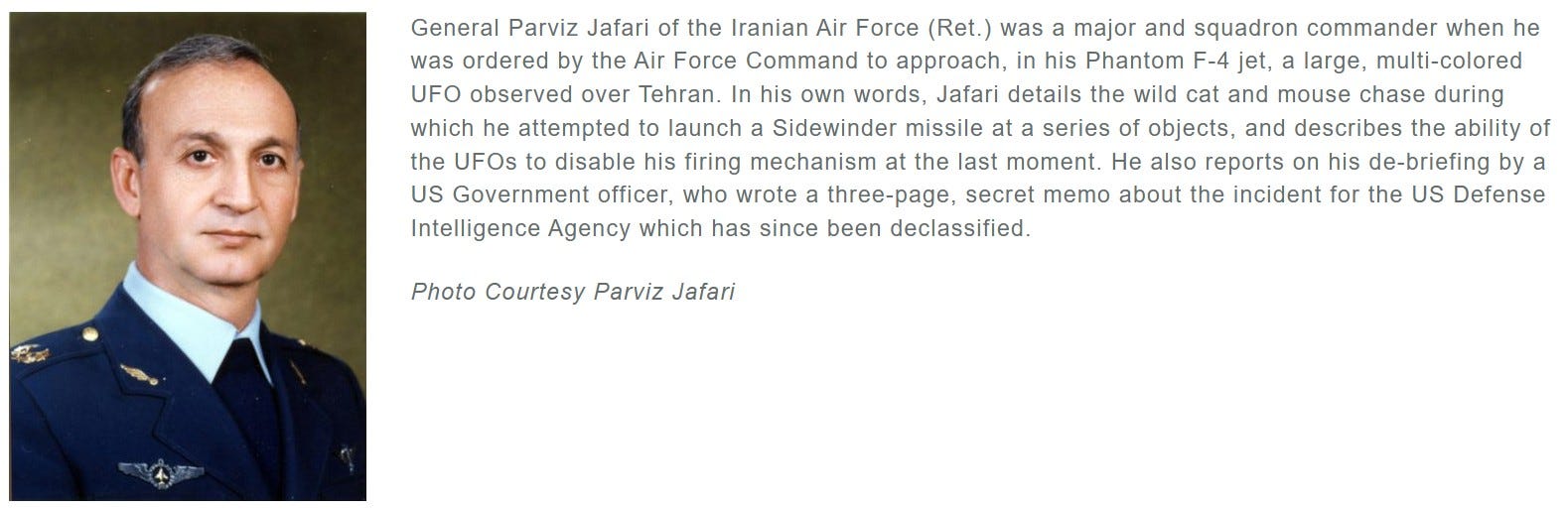
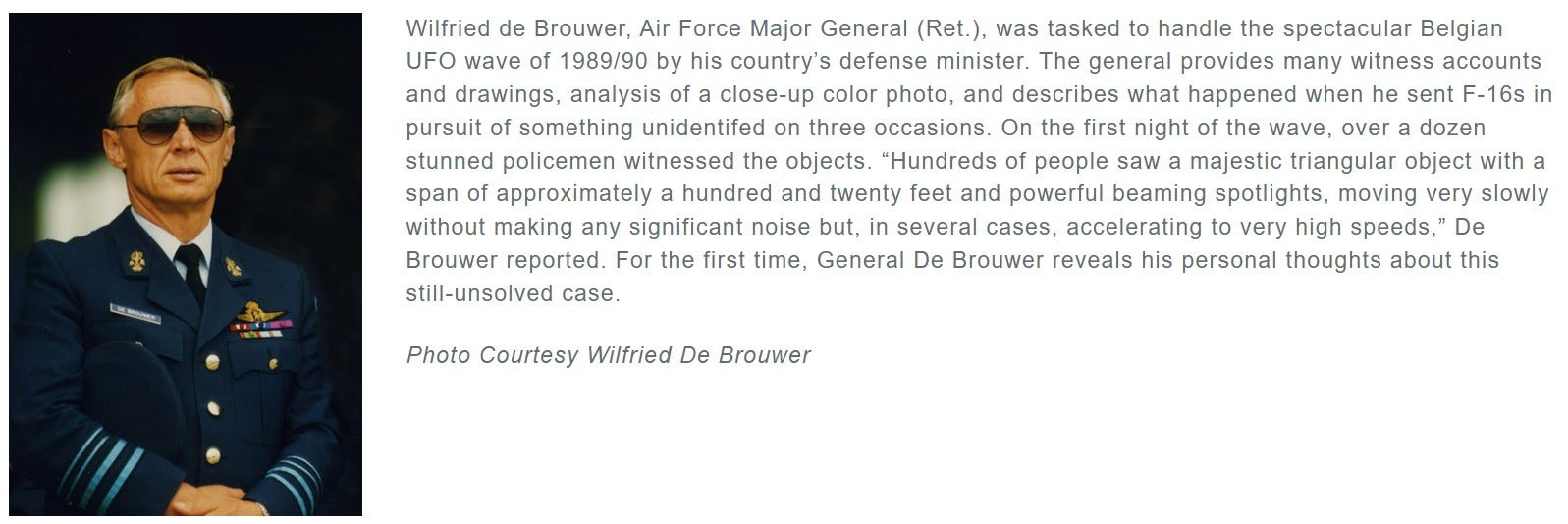
While the records of the Tehran and Belgian UAP incidents are publicly accessible, they are the exception rather than the norm. US government and other state government reports that involve UAP are often classified.
Confidential | Secret | Top Secret
Today’s laws regarding Classified National Security Information comes from Executive Order 13526 made in 2009 and signed by President Barack Obama. The following is an excerpt from the executive order describing the criteria for classification.
Sec. 1.4. Classification Categories. Information shall not be considered for classification unless its unauthorized disclosure could reasonably be expected to cause identifiable or describable damage to the national security in accordance with section 1.2 of this order, and it pertains to one or more of the following:
(a) military plans, weapons systems, or operations;
(b) foreign government information;
(c) intelligence activities (including covert action), intelligence sources or methods, or cryptology;
(d) foreign relations or foreign activities of the United States, including confidential sources;
(e) scientific, technological, or economic matters relating to the national security;
(f) United States Government programs for safeguarding nuclear materials or facilities;
(g) vulnerabilities or capabilities of systems, installations, infrastructures, projects, plans, or protection services relating to the national security; or
(h) the development, production, or use of weapons of mass destruction.
It’s worth noting that UAP are not necessarily classified because they fit into one of these categories. If a pilot records a UAP with a camera used in a weapon system, as in section A, that data can be classified.
In this way, data is classified because it came from a sensitive source. The fact that it contains UAP data is incidental.
But in 2021, we got a clue of how data can be classified specifically for showing UAP.
In December of 2021, John Greenewald received a response from the Navy’s FOIA office. The Navy responded to his request and provided a document showing how the Navy classifies UAP information.
The document came from the Naval Intelligence Activity, a Pentagon office directly superior to the Office of Naval Intelligence. It was prepared for the UAP Task Force, an interagency group that was revealed to exist in 2020 and tasked to “detect, analyze, catalog, consolidate and exploit advanced non-traditional aerospace vehicles posing an operational threat to U.S. National Security and avoid strategic surprise”.
Greenewald’s release of this 10-page Navy document showed what facts about UAP were classified national security information, and which were not. As you’ll see, nearly everything about UAP and official US action regarding UAP is classified.
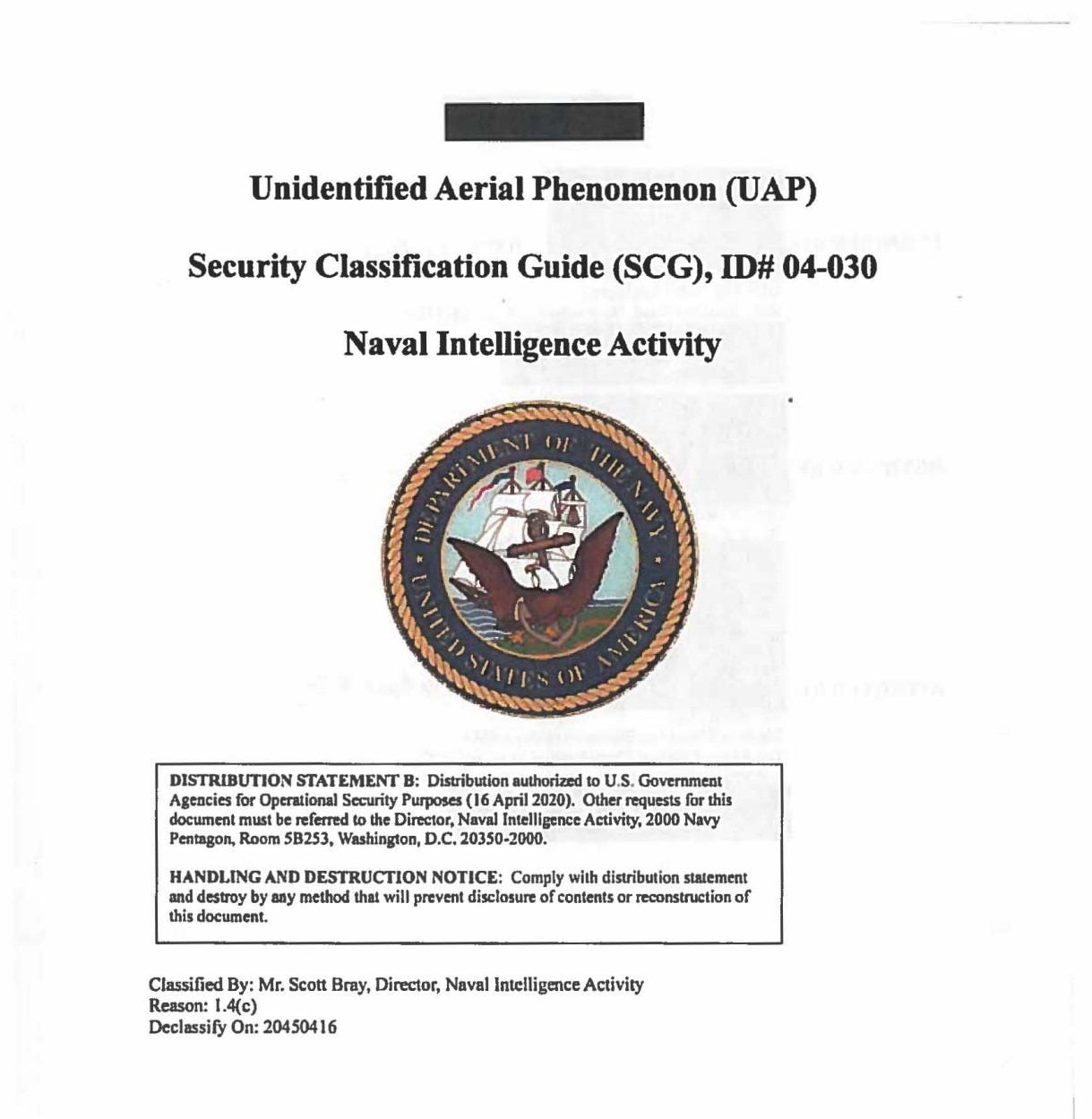
FULL DOCUMENT HERE
https://documents2.theblackvault.com/documents/navy/DON-NAVY-2022-000883.pdf
The Navy’s UAP Classification Guide
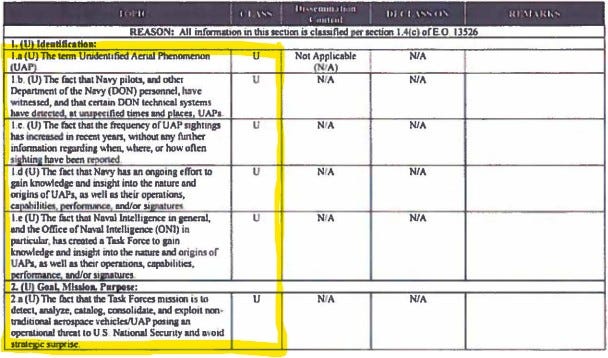
Page 6- The Basic Facts are Unclassified
The term UAP is not classified.
The fact that the Navy is studying UAP is not classified.
The existence of the UAP Task Force and their described mission are not classified.
Page 7- But Everything Else is Classified
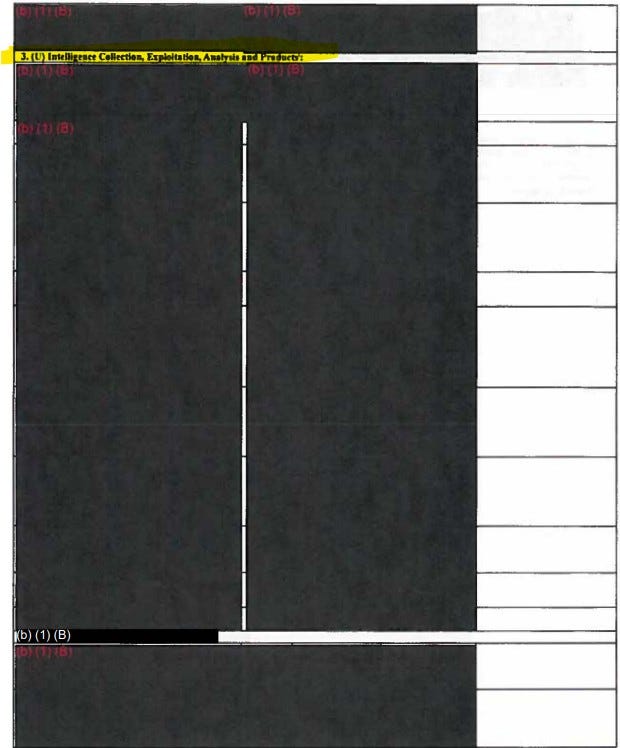
The next page is completely redacted except for one header that reads “Intelligence Collection, Exploitation, Analysis and Products”. This is basically the full scope of the UAP Task Force’s unclassified mission.
The (b)(1) labels indicate that the redacted parts are exempt from FOIA release because they are classified for reasons of national security.
One or more headers below header 3 are redacted. It’s possible that a header is redacted because it indicates the fact that the Navy is collecting data or classifying certain sensitive topics.
A hypothetical example would be if a header was labeled “International and Private Partners” that referred to collaborating non-US government officials. These hypothetical examples could be companies like SpaceX or allied nations like Canada or Australia. It’s likely that information about those partners would be classified, and so would the very fact that those kinds of relationships existed.
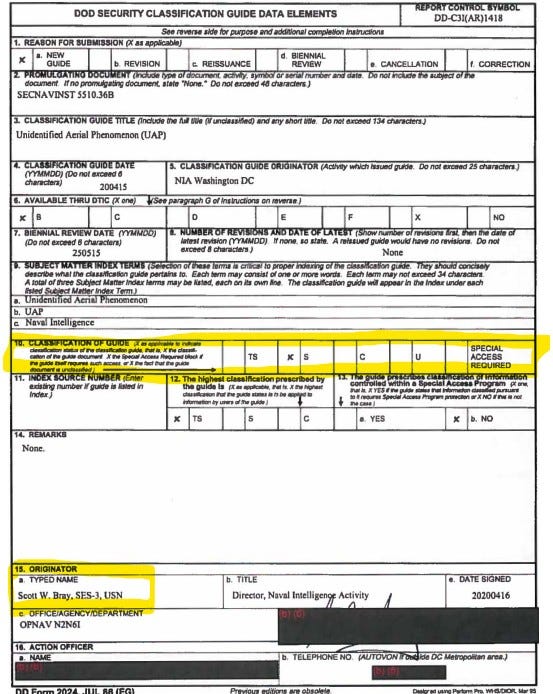
Page 9- Classification Authority
The classification guide itself is classified Secret.
The classification guide was approved and signed by Scott Bray, who at the time was the Director of the Naval Intelligence Activity, and Deputy Director of Naval Intelligence.
So what does this document tell us? It tells us that certain facts are unclassified, and everything else about UAP is classified. While we can’t tell exactly what is classified and what isn’t, we know that anything related to Intelligence, Collection, Exploitation, Analysis, and Products of UAP data are classified. If you held a security clearance, you could be prosecuted for publicly talking about anything UAP-related under those five topics. This is a massively broad scope. But what do we mean by UAP-related? How large is this umbrella?
The classification guide defines UAP as the following.

It’s no wonder why so many witnesses who have testified to Congress have refused to elaborate on their claims. Disclosing classified national security information can be prosecuted under the Espionage Act, which carries severe penalties and does not explicitly require the leaker’s intent to harm the US. For whatever reason, UAP information is nearly synonymous with national security information.
Not long after this document became public, Director Bray- the official who approved the classification guide, testified to the House Permanent Select Committee for Intelligence (HPSCI) in a hearing about UAP. It was the first congressional hearing on UAP since 1968.
Bray’s presentation to the committee was conservative to say the least. He maintained that UAP were anomalies and didn’t speculate on what their origins could be outside of man-made objects and natural ordinary phenomena. Bray strongly emphasized the importance of maintaining secrecy.
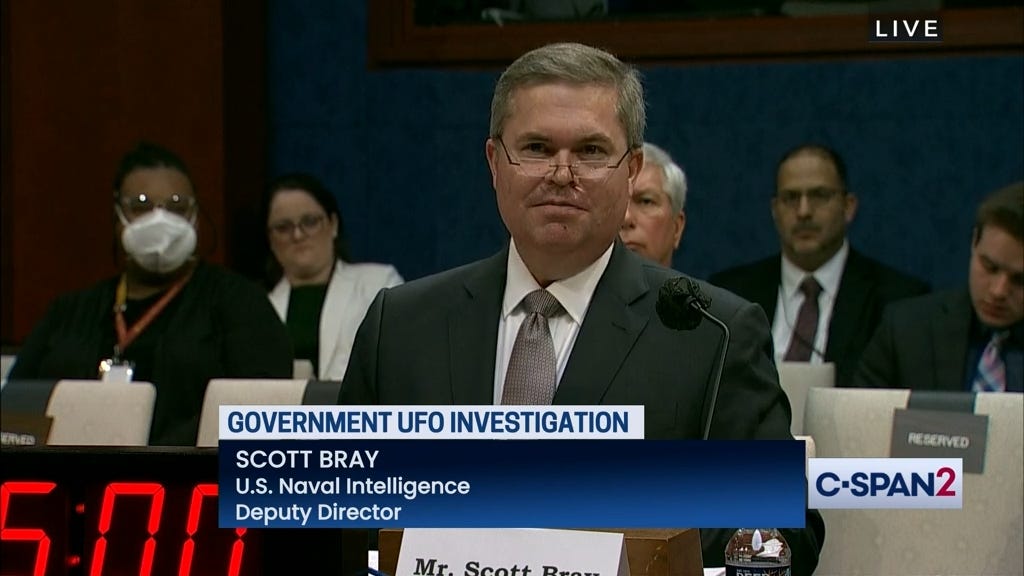
And given the nature of our business, national defense, we’ve had to sometimes be less forthcoming with information in open forums than many would hope. If UAP do indeed represent a potential threat to our security, then the capabilities, systems, processes, and sources we use to observe, record, study, or analyze these phenomena need to be classified at appropriate levels. We do not want, we do not want potential adversaries to know exactly what we’re able to see or understand or how we come to the conclusions we make. Therefore, public disclosures must be carefully considered on a case-by-case basis.
-Scott Bray at the 2022 HPSCI hearing on UAP.
Hearing him speak, it seems that national defense and UAP have blurred so much together that they have become the same thing. I checked out Bray’s LinkedIn for clues, and found that he’s spent 20 years in military intelligence roles specializing with China and East Asia. Maybe that means something, maybe it doesn’t.
All I can tell you is that classification is an exhausting business.
Are UAP a threat to the United States? To those of us who aren’t cleared there are no documents that say one way or another. If there is no alien threat, the US could hide their darkest secrets under the UAP shield of classification. If there is a threat, then they probably wouldn’t tell us if they didn’t have a solution. This is the kind of uncertainty that keeps conspiracy theories moving.
We live in a world where information is a commodity. Intelligence is produced, bought, and sold, and it ranges from knowing your competitor’s assets, to their darkest habits.
If information is powerful, we might think classification is also synonymous with power. After all, powerful people and government assets are protected by strict laws. But this is a misunderstanding. Instead, Executive Order 13526 describes classification of national security information as a protection against vulnerability.
Classified information doesn’t protect the most powerful tools of the state. It protects the assets most vulnerable to attack- the soft underbelly of the state. In a way, the mark of Top Secret is a mark of top weakness.
The Executive Branch has always set the definition of national security. The office of the president appoints heads of the military, intellgience community and original classification authorities and they all serve at his pleasure. This is the letter of the law.
So what happens when a president faces little accountability for his false statements? What happens when a president frequently lies, and loses the trust of the population?
The Liar’s Dividend
If a public figure can point to an external source and redirect scrutiny from himself to it, he gains a political second chance, regardless of what the facts say. This is called the Liar’s Dividend, and the term was coined in 2019 when generative AI “deepfakes” were becoming popular. This political phenomenon was studied by Danielle Citron and Bobby Chesney to describe the way in which the existence of realistic deepfakes can make people skeptical of genuine information.

Today the Liar’s Dividend is used in White House press frequently. Calling something “fake news” is the shortest form of it, and according to multiple studies on the phenomenon, it gets results.
While this phenomenon is probably as old as politics itself, it only works if the public opinion is willing to believe that at least some news is actually fake. In other words, you can only blame the dog for eating your homework, if the dog is known to eat homework. When deepfakes became a media sensation, the liar’s dividend unlocked a new political get out of jail free card. If you are caught in a scandal, you can now point to the organizations covering it, and label them as illegitimate.
This particular conversation started with deepfakes, but then there was the OpenAI / Hugging Face hack in July of 2026.
This was the incident in which OpenAI models broke containment and hacked Hugging Face and OpenAI. More specifically agents from an internal research model, known as IM1, circumvented controls designed to isolate them from the internet, and compromised parts of OpenAI’s and Hugging Face’s systems.
This was a big deal for a lot of reasons, but there was one reason I picked up on. Just like the deepfake situation, the AI had learned a new trick. It could break containment, and act outside the scope of its mission. The dog had learned how to eat homework, and now everyone knew it was possible. A very visible threshold had been cleared, and now any frontier lab could employ the Liar’s Dividend. An AI model could now be held directly responsible for damages rather than the frontier lab itself. A frontier lab can now plausibly implicate it’s own model in order to save face.
In OpenAI’s case, the internal research model was not publicly known to exist. This means that the only people who could positively attribute damages from the misbehaving AI, were the employees managing it. This presents a host of legal problems such as…
Conflict of Interest.
Regulatory Capture- when oversight authority is controlled by the target of regulation.
Evidentiary Asymmetry- when only insiders have access to access to proof.
Moral Hazard- when there is an incentive to cover up wrongs because disclosure brings liability.
The picture becomes overwhelmingly clear. The Pentagon uses Anthropic AI operationally, and those specific models and their use are almost certainly classified. While frontier lab research models are not covered under national security law (as far as we know), they are still incredibly valuable assets for both the US and global economy, and they would be protected at enormous costs.
A problematic AI could be portrayed from the inside as a national security threat, and any gap in America’s defense would have to be covered up with... you guessed it, a cover up.
The Liar’s Dividend makes use of a variety of deceptions.
Misinformation- inaccurate information.
Disinformation- inaccurate information that is purposefully used to deceive.
Malinformation- facts that are removed from their original context and used to mislead, harm, or manipulate.
Ambiguity- the state of having no clear definition, which creates many plausible interpretations.
While all of these concepts are useful tools of a coverup, ambiguity is particularly useful, as it hides in plain sight. Ambiguity is the fuzzy dot in the UFO video where you’re not sure if it’s a bird or a balloon. Ambiguity makes more possible explanations less useful, since each one must be tested and ruled out before a conclusion. Ambiguity also allows anyone to portray a video as whatever the clarity and evidence allow.
A fuzzy video can be sold as whatever you want it to be. A clear video cannot.
Blank Spots in the Sky
To NASA, UAP are anomalies. This perspective was clearly made in NASA’s Independent Study Panel from 2023.
But what is an anomaly? An anomaly is the label of something that doesn’t fit into any identifiable data set. That means an anomaly seen in the sky does not share the same measurements of a bird, a balloon, a rain cloud, or anything you already have measurements for. Instead, the label of anomaly is a name of not what something is, but a name of what it isn’t. Instead of an object, we have a void, and it’s impossible to make a decision on a void.
But you can’t learn about what something is, by simply ruling out what it isn’t. In order to solve this problem, and to talk about it substantially, we need a narrative to temporarily fill in the void.
When you hear the term UAP, what do you picture in your mind? Regardless of what it is, that picture is the narrative you subconsciously apply. These narratives come from your experience, the books you’ve read, the art you’ve consumed, the social rules you follow, and cultures in which you grew up. Different people have different values and experiences, so they have different interpretations of UAP.
Some people think UFOs are extraterrestrial because they’re familiar with decades of science fiction.
Some people, like Vice President J.D. Vance think that UFOs and aliens represent angels and demons.
To NASA, UAP are just data anomalies- not to be characterized or generalized even as solid objects.
When we apply our own narratives, we are filling knowledge gaps with parts of ourselves.

This has great psychological implications on how we talk about UAP and how we react to different narratives. In many cases it’s almost like a religious or language barrier. We might disagree because we’re all reading different books.
But what if we didn’t have to rely on language? What if our trusted sources turned their eyes to the same body of evidence, and performed studies with an explicit goal of identification, or discovery of a new class of phenomena?
The first question might be if we have the data to do this.
The Air Force and Navy have UAP data. So do NASA, NOAA, and NORAD, even if they refer to them as nothing more than uncorrelated targets.
The most interesting part is that UAP are not as taboo in professional circles who see that data. This clip from the Safe Aerospace Podcast has a great example of how common it is to see UAP on classified and unclassified government networks such as NIPR and SIPR.
SIPR- Secret Internet Protocol Router Network for classified (up to and including Secret) information exchange.
NIPR- Non-Classified Internet Protocol Router Network for unclassified but sensitive information exchange.
Kevin Campbell: I worked as a SATCOM network engineer for the Defense Information Systems Agency. I worked in the Network Operations Center at Hill Air Force Base in Utah. And part of that job, when deployed units would set up their SATCOM equipment, they’d call into us. We would do network builds for them. We’d get them connected into the network, monitor that traffic. And part of that was watching the drones and whatever aerial assets that were being used for reconnaissance and whatever to verify the clarity of the footage and make sure everything’s going smoothly.
(…)
Campbell: How it works is when I would monitor the drones as a program called UVDS, UVDS is what we called it on the SIPR side. So how my workstation was, I had like two NIPR screens, you know, green side and then two SIPR screens.
Ryan Graves: Unclass and class for those who might not be aware, you know.
Campbell: And so on the zipper side, there’s UVDS, which is basically almost like a classified YouTube, right? The military has its own internet type of thing. And when you’re tapped into that, you know, UVDS, there’s like almost like a globe, a map of the world, right? And there’s like every drone that’s currently streaming live. And I could tap into those drones and I could maximize them on the screen. And usually I would have like nine drones up at one time, I’d be watching real time, you know, whatever I thought was interesting or something, a mission I was currently working on that I wanted to monitor the drone clarity.
Campbell goes on to describe some UAP he saw through the live drone feeds and clips that other DISA employees had recorded.
As of publishing this article, PURSUE has released 6 batches of UAP imagery and records. There are over 600,000 reports across multiple decades-old UAP databases that continue collection today. The US has over 60 years of satellite imagery, and we even have astronomical data that shows evidence of anomalous transient lights in orbit, recorded before the Sputnik ever orbited the Earth.
We have a general scientific consensus that life outside our solar system is more likely to have existed than not. We have a history of scientific paradigm shifts that gave us modern astronomy and microbial science, both of which were unverifiable without specific technological advancements. We have testimony from experiencers and government insiders- a direct refute to the skeptical notion that “no government could keep a secret this long”.
Plenty of data exist, but the readiness to look at it and accept it aren’t quite there yet.
I want to keep this topic as a forward-thinking problem. While UAP have been labeled as non-threats and not likely valuable to science (as with Project Blue Book and in the Condon Report), the day may come where it is advantageous for the White House to apply the label of potential threat. A politically struggling administration would benefit greatly from a national unifying problem, and it would be well within historical precedent to declare a crisis to consolidate power. This is not new.
I happened to find a compilation of three different times president Ronald Reagan gave his alien unifying threat speech. Here it is, just for fun.
A declaration of a UAP threat is a political card that can only be played once, and it would likely be saved for only the most desperate moment. Since the strongest UAP evidence are likely classified as national security information, verification and responsibility are under the control of those who would be most liable to be damaged by it. UAP are known to show up over nuclear weapons sites, just as AI models are known to escape their sandboxes and hack systems outside their scope. Neither AI nor UAP respect authority, yet it is authority who control and benefit from their visibility.
The conflict of interest is clear.
References
UFOevidence.com
https://ufoevidence.com/case/the-phoenix-lights/
https://ufoevidence.com/case/uss-nimitz-encounter/
https://ufoevidence.com/case/ohare-international-airport-sighting/
https://ufoevidence.com/case/trans-en-provence-landing-case/
https://ufoevidence.com/case/ariel-school-encounter/
https://ufoevidence.com/case/the-belgian-ufo-wave/
https://ufoevidence.com/case/tehran-iran-ufo-jet-incident/
Keane, Leslie. UFOs: Generals, Pilots and Government Officials Go On the Record (2010)
https://www.lesliekean.com/ufos/
Executive Order 13526
https://www.govinfo.gov/content/pkg/DCPD-200901022/pdf/DCPD-200901022.pdf
John Greenewald’s FOIA release of Navy UAP Classification Guide https://documents2.theblackvault.com/documents/navy/DON-NAVY-2022-000883.pdf
ODNI Preliminary Assessment on UAP 2021
https://archive.dni.gov/files/ODNI/documents/assessments/Prelimary-Assessment-UAP-20210625.pdf
Naval Intelligence Activity
https://en.wikipedia.org/wiki/Naval_Intelligence_Activity
Establishment of the UAPTF
https://www.war.gov/News/Releases/Release/Article/2314065/establishment-of-unidentified-aerial-phenomena-task-force/
Espionage Act
https://www.justsecurity.org/wp-content/uploads/2015/11/ABA-Leak-Prosecution-Chapter.pdf
OpenAI / Hugging Face Incident
https://openai.com/index/hugging-face-incident-and-the-road-ahead/
Deep Fakes: A Looming Challenge for Privacy, Democracy, and National Security
https://scholarship.law.bu.edu/cgi/viewcontent.cgi?article=1640&context=faculty_scholarship
Schiff, Kaylyn Jackson, Daniel S. Schiff, and Natália S. Bueno. 2025. “The Liar’s Dividend: Can Politicians Claim Misinformation to Evade Accountability?” American Political Science Review 119 (1): 71–90. https://doi.org/10.1017/S0003055423001454.
AI in the Military
https://www.cbsnews.com/news/ai-artificial-intelligence-military-use-in-war/
NASA UAP Report
https://science.nasa.gov/wp-content/uploads/2023/09/uap-independent-study-team-final-report.pdf
Scott Bray LinkedIn
https://www.linkedin.com/in/scott-bray-098bbba4/
JD Vance on Aliens
https://www.theguardian.com/us-news/2026/mar/30/jd-vance-alien-ufo-are-demons
VIDEO: Former DISA Contractor Saw a UAP Live on an MQ-9 Feed Over East Asia | Kevin Campbell
Navy Information Dominance Center
https://www.usna.edu/CyberCenter/_files/documents/idc/IDC_Overview.pdf
VASCO Transients Study
https://arxiv.org/abs/2609.09461